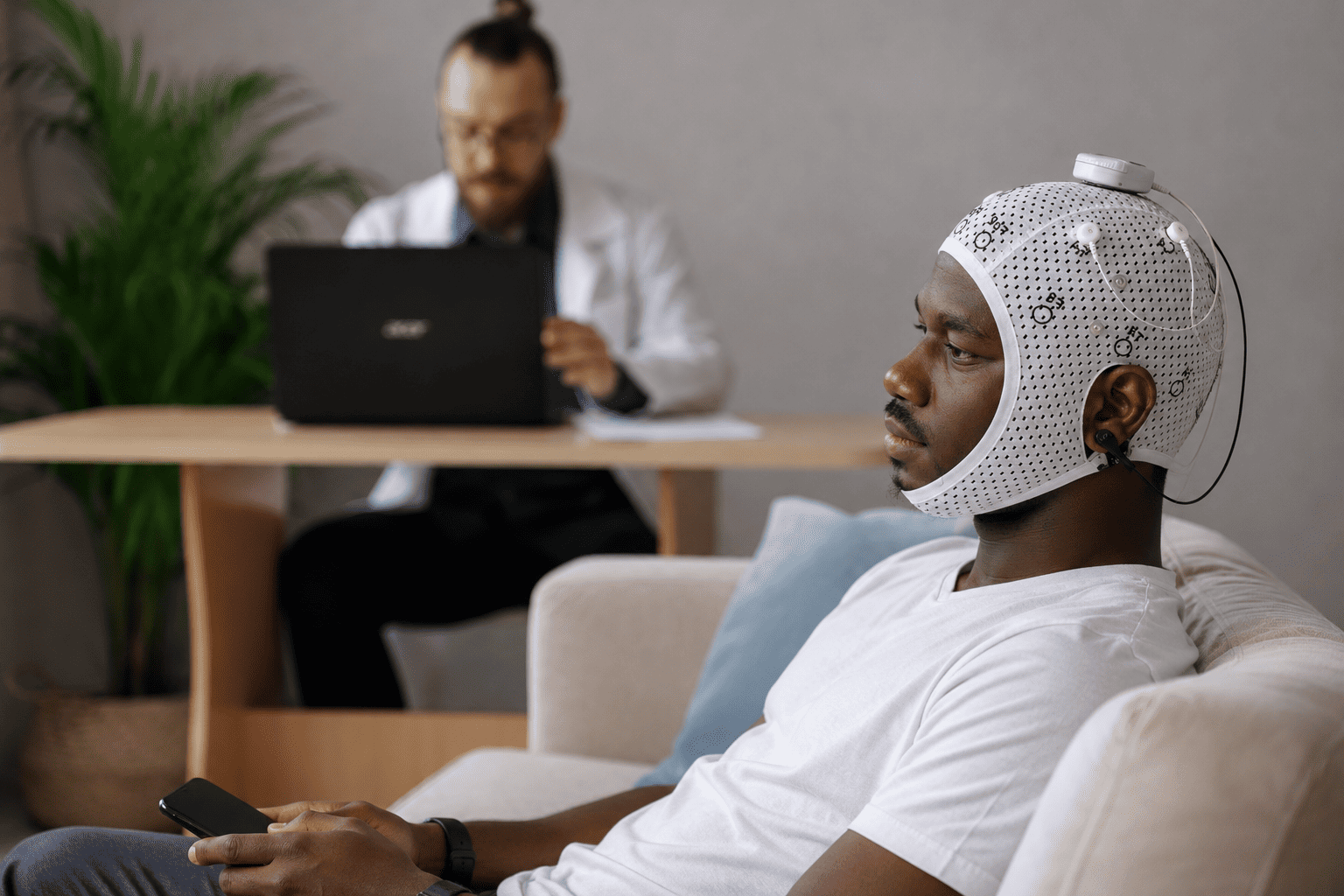
Neurofeedback is a type of biofeedback that shows you your own brain activity in real time, so you can practice changing it. Sensors on the scalp record electrical signals from the brain (EEG), software analyzes them, and a game, sound, or animation responds when your brain activity moves in a target direction. Over many sessions, the idea is that you learn to regulate your own mental state. This is why neurofeedback is also called EEG biofeedback or brain training.
This guide explains what neurofeedback is, how it works, where it came from, what equipment it uses, what people use it for, and, importantly, what the research actually says. We also give you a checklist for choosing a practitioner or device.
What Is Neurofeedback? The Short Answer
Neurofeedback is a non-invasive training method that uses a real-time display of brain activity to teach self-regulation. It rests on a simple principle called operant conditioning: behavior that is followed by a reward becomes more likely. In neurofeedback, the "behavior" is a pattern of brain activity, and the "reward" is a visual or audio signal that tells you the pattern is moving the right way.
Four things make up every neurofeedback system:
- EEG recording: sensors measure the brain's electrical activity from the scalp.
- Real-time analysis: software extracts features, such as the strength of certain brain rhythms.
- Feedback: a game, video, sound, or progress bar responds instantly to those features.
- Repeated practice: the person trains over multiple sessions and tracks progress over time.
Neurofeedback does not send electricity into the brain. The sensors only listen. That separates it from brain stimulation methods such as TMS or tDCS, which deliver energy to the brain.
How Does Neurofeedback Work?
The Feedback Loop
The brain produces tiny electrical signals from the activity of billions of neurons. EEG picks up the combined result as waves at different speeds, measured in hertz (Hz). A neurofeedback system measures one or more of these rhythms and turns them into a signal you can see or hear.
Here is a simple example. Imagine a balloon on a screen that rises when your measured brain activity stays in a chosen "target zone," and sinks when it leaves. You do not control the balloon with your hands. You find, by trial and error, mental states that make it rise. When the balloon rises, the feedback rewards that state. Repeated many times, the brain may learn to reach that state more easily.
The Main Brain Rhythms
Most neurofeedback works with a handful of frequency bands. The associations below are simplified. In real brains, the same rhythm can mean different things depending on where it is recorded and what the person is doing.
| Rhythm | Approximate range | Commonly associated with |
| Delta | 0.5–4 Hz | Deep sleep |
| Theta | 4–8 Hz | Drowsiness, deep relaxation, some meditative states |
| Alpha | 8–12 Hz | Relaxed wakefulness, calm with eyes closed |
| SMR (sensorimotor rhythm) | 12–15 Hz | Calm, physical stillness with alertness |
| Beta | 13–30 Hz | Active thinking, concentration, also tension at high levels |
| Gamma | 30 Hz and above | High-level processing; difficult to measure cleanly with scalp EEG |
If you want a deeper explanation, read our guide to alpha, beta, and theta waves in neurofeedback.
What a Typical Session Looks Like
A session usually follows the same pattern:
1. Setup. The sensors are placed on the head. With modern dry-electrode headbands, this takes only a few minutes and needs no gel.
2. Baseline. The system records a short period of resting EEG so it can set thresholds suited to the person.
3. Training. The person plays a neurofeedback game, watches a video that stays clear or bright when the target is met, or listens to sound that changes with their brain activity. A session often lasts 15 to 30 minutes.
4. Review. The software shows a session report, and the practitioner or user adjusts thresholds and goals.
BrainBit's professional workflow, for example, describes five steps: onboard and evaluate the baseline, prepare a protocol, begin training with gamified sessions, track progress, and refine based on the trends. Protocols typically involve 15 or more sessions, because learning takes repetition.
A Short History of Neurofeedback
Neurofeedback grew out of the broader biofeedback movement of the mid-20th century.
Late 1950s: Joe Kamiya, working at the University of Chicago, showed that people could learn to recognize and control their alpha rhythm when given feedback. He is often called the father of neurofeedback.
1960s–1970s: Barry Sterman found that cats trained to produce a specific rhythm over the sensorimotor cortex (SMR) showed changes in sleep and in their resistance to seizure-inducing chemicals. A 1972 paper by Sterman and Friar reported seizure reduction in a person who trained this rhythm, which opened the door to clinical research.
1970s onward: Joel Lubar and others began exploring neurofeedback for attention problems, which led to decades of work on ADHD and related topics.
1990s to today: Quantitative EEG (qEEG) mapping, Z-score training, and source-localization methods such as LORETA added more complex approaches. In recent years, wearable dry-electrode EEG has moved neurofeedback out of the lab and into homes, schools, and small practices.
The field has a long history, but its research quality has been uneven. For many years, studies were small and poorly controlled, which is why the evidence section below matters.
Types of Neurofeedback
Not all neurofeedback is the same. Common approaches include:
- Frequency band training. The most common type. The system rewards an increase or decrease of specific rhythms, such as raising SMR or lowering excess theta, at chosen scalp locations.
- qEEG- or Z-score-guided training. A recording of resting EEG is compared with a reference database, and training targets sites that differ from the average. This usually requires multi-channel equipment and trained staff. BrainBit supports this style of workflow through its DragonEEG and NeuroGuide bundle.
- Slow cortical potential (SCP) training. The person learns to shift very slow voltage changes in the brain.
- LORETA and source-based training. Advanced methods that estimate activity in deeper regions from multi-channel EEG.
- Alpha-theta training. Used for deep relaxation and some meditation-style practice.
- Related methods. Feedback can also come from other signals, such as heart rate variability, muscle tension (EMG), skin conductance, or breathing. Multi-sensor systems such as Callibri sensors combine these with EEG.
What Equipment Does Neurofeedback Need?
A basic neurofeedback setup needs three things.
1. An EEG device. This ranges from a 1-channel sensor to a 4- or 8-channel wearable headband, up to a 21-channel system for brain mapping. More channels give broader coverage but need more setup and expertise. For simple focus and relaxation training, a 4-channel wearable is often enough. Our article on how EEG headbands work explains the technology, and the BrainBit headband comparison helps you pick a model.
2. Software. The software processes the signal, filters out artifacts, sets thresholds, and provides the feedback. Examples include NeuroFit PRO for guided protocols and session reports, and the BrainBit Neurofeedback App for mobile sessions.
3. A feedback display. This is usually a screen, headphones, or both. Many people prefer engaging neurofeedback games over plain bar charts because they keep users motivated across many sessions.
Signal quality matters more than any extra feature. Movement, blinks, and muscle tension create artifacts that can fool the feedback loop, so good hardware and artifact detection are important. See our guide to common EEG artifacts. For a full shopping overview, read What Do You Need for Neurofeedback Training? and How to Choose an EEG Device for Neurofeedback.
What Is Neurofeedback Used For?
People use neurofeedback in several settings. The following are the common wellness, training, and research uses. These are not medical claims.
- Focus and attention practice. Users train to maintain steady attention during a task.
- Relaxation and stress management. Feedback helps people notice and practice calm states.
- Meditation support. Real-time feedback can show how meditation affects brain activity. See neurofeedback for meditation.
- Sleep routines. Some programs use relaxation training as part of a bedtime routine. Explore our sleep page.
- Performance coaching. Athletes, musicians, and professionals use it to practice focus under pressure. See coaching applications.
- Education and research. Universities and labs use wearable EEG to teach neuroscience and to run studies.
Neurofeedback is also discussed in connection with conditions such as ADHD, anxiety, PTSD, insomnia, and autism. That is where careful reading of the research is essential, as the next section explains.
What Does the Research Say?
This is the question that matters most, and the honest answer is: the evidence is mixed, and it depends on the goal.
ADHD: The Most-Studied Case
ADHD is the condition with the most neurofeedback trials, and the recent results are cautious.
- A 2025 systematic review and meta-analysis in JAMA Psychiatry pooled randomized trials of neurofeedback for ADHD. It included 38 trials with 2,472 participants. When it looked only at ratings made by people probably unaware of who received the real treatment, it found no meaningful improvement in ADHD symptoms at the group level. The authors concluded that neurofeedback did not appear to benefit people with ADHD clinically or neuropsychologically on average.
- An earlier 2016 meta-analysis by the European ADHD Guidelines Group found a similar pattern. Effects appeared when ratings came from people close to the treatment, such as parents, who knew about it, but were not significant when ratings came from probably blinded observers or when trials used active or sham controls.
- Reviewers also point out that few trials checked whether participants actually learned to control their brain activity, which is the core premise of the method.
These findings do not prove that neurofeedback never helps any individual. The 2025 authors suggested that future studies should look for subgroups who might respond, use standard protocols, and confirm that learning takes place. But they do mean that neurofeedback should not be presented as a proven treatment for ADHD, and that families should talk with a qualified clinician about evidence-based options.
Sleep and Insomnia
A review of neurofeedback for insomnia found only 12 experimental studies and concluded that more robust designs and replication are needed before neurofeedback can be supported as an effective treatment.
Why Neurofeedback Is Hard to Study
Several things make neurofeedback research difficult:
- Placebo and expectation effects. Sitting calmly and playing a game with a caring practitioner can improve how people feel, whatever the protocol does to the brain.
- Sham controls are tricky. A convincing fake feedback condition is hard to design and can itself give people practice at relaxing.
- Wide variety of protocols. Different sites, frequencies, session counts, and software make studies hard to compare.
- Individual differences. Some people appear to learn to regulate their EEG, while others do not, and trials rarely measure this.
What This Means for You
In practice, a sensible way to think about neurofeedback is as a self-regulation and skills-practice tool, similar to meditation or other biofeedback methods, rather than as a cure. It can make internal states visible and give structure to a practice, but it should not replace medical care or evidence-based treatment for a health condition. This is the reason BrainBit positions its products as non-medical devices for wellness, education, research, and software development, not for diagnosing, treating, or curing any condition.
If you want to read the research yourself, the sources are listed at the end of this article.
Is Neurofeedback Safe?
Because EEG neurofeedback only records brain activity and does not deliver stimulation, it is generally considered low risk. Some people report mild effects after sessions, such as tiredness, headache, restlessness, or feeling "off" for a short time, especially after long or intense sessions. If you experience unusual symptoms, stop and speak to a professional.
Safety is also about expectations and decisions. Be cautious about:
- Stopping or changing prescribed medication because of neurofeedback
- Delaying medical or psychological care for a serious problem
- Providers who promise cures or guaranteed results
If you have a medical condition, a history of seizures, or you are considering neurofeedback for a child, talk to your doctor first.
How Many Sessions Does Neurofeedback Take?
There is no single answer. Learning a skill takes repetition, so programs usually involve many sessions over several weeks or months. BrainBit's professional workflow describes typical protocols of 15 or more sessions, and some clinics run longer programs. Session frequency (for example, two or three times per week) depends on the protocol and the person. Be wary of anyone who promises a fixed result after a set number of sessions.
Neurofeedback vs Biofeedback vs Meditation vs Brain Stimulation
| Method | What it measures or does | Active or passive? |
| Neurofeedback | Measures brain activity (EEG) and gives feedback | Active: you practice regulation |
| Biofeedback | Measures body signals such as heart rate, muscle tension, breathing, or skin conductance | Active |
| Meditation | Mental practice with no measurement unless combined with a device | Active |
| Brain stimulation (TMS, tDCS) | Delivers magnetic or electrical stimulation to the brain | Mostly passive; done to you |
Neurofeedback is a type of biofeedback, and it combines well with meditation, because the feedback can show how a practice affects your brain in real time. Products like Attune with the BrainBit Headband are built around that idea.
Neurofeedback at Home vs With a Professional
At-home neurofeedback uses a wearable headband and a mobile or desktop app. It is convenient, affordable, and suited to general wellness, meditation, and focus practice. A device like MINDO is designed for this use, with guided sessions and progress tracking.
Professional neurofeedback involves a trained practitioner who sets up protocols, monitors signal quality, adjusts thresholds, and guides the person. It may use more channels, qEEG mapping, and structured session plans. Professionals can also help users set realistic expectations and refer them to other care when needed. If you work with clients, see our page on professional neurofeedback solutions.
A hybrid approach is also common: sessions in the office, plus assigned practice at home with a companion app.
How to Choose a Neurofeedback Provider or Device
Use this checklist.
For a provider:
- Look for training and certification, for example through the Biofeedback Certification International Alliance (BCIA) or membership in the International Society for Neurofeedback and Research (ISNR).
- Ask what protocol they use, why, and how they will measure progress.
- Ask how they check that you are actually learning to change the target signal.
- Be cautious about promises to cure a condition, or about brain mapping that is presented as a required diagnosis.
- Make sure your doctor knows about your plans.
For a device:
- Check the number of channels and electrode positions against your goals.
- Look for artifact detection, raw data access, and clear specifications such as sampling rate.
- Check that the company states honestly what the device is for. A non-medical wellness or research device should say so.
- Consider software, support, and warranty, not just the hardware.
- If you are a developer, check for a free SDK and documentation.
Getting Started With BrainBit
BrainBit makes wireless, dry-electrode EEG headbands and software for neurofeedback, research, education, and app development. Here is where to begin:
- For home focus and meditation practice: MINDO with the BrainBit Neurofeedback App
- For practitioners, coaches, and developers: the BrainBit Headband with NeuroFit PRO
- For richer coverage in studies and advanced protocols: Headband Pro (8 channels)
- For multi-channel mapping and qEEG workflows: DragonEEG
Not sure which to pick? Read our headband comparison guide, or request a demo and talk to the team.
BrainBit products are non-medical and are not intended to diagnose, treat, or cure any condition.
Frequently Asked Questions
What is neurofeedback in simple words?
Neurofeedback is a way to watch your own brain activity in real time and practice changing it. Sensors record your EEG, and a game or sound reacts when your brain activity moves toward a target. With repetition, people aim to get better at regulating their focus, relaxation, or alertness.
How does neurofeedback work?
It works through operant conditioning. The system measures a feature of your EEG, compares it to a target, and gives instant feedback. When your brain activity moves the right way, you get a reward signal. Over many sessions, the brain may learn to produce that state more easily.
Is neurofeedback the same as EEG biofeedback?
Yes. The terms mean the same thing in most contexts. Neurofeedback and EEG biofeedback both refer to training with real-time feedback of brain activity measured by EEG.
Does neurofeedback really work?
It depends on the goal. For general self-regulation practice, many users and practitioners value it, but high-quality evidence is limited. For ADHD, a 2025 meta-analysis of blinded trials did not find a meaningful group-level benefit, and for insomnia the research base is still small. Neurofeedback should not be treated as a proven medical treatment.
Is neurofeedback safe?
EEG neurofeedback is non-invasive and does not send electricity into the brain, so it is generally considered low risk. Some people report mild tiredness or headache after sessions. Talk to a doctor if you have a medical condition or are considering it for a child.
How many neurofeedback sessions do I need?
Programs usually involve many sessions, often 15 or more, because learning takes repetition. The right number depends on your goal and protocol. Avoid providers who guarantee results.
Can I do neurofeedback at home?
Yes, for general wellness and practice. Wearable headbands and mobile apps make home sessions possible. For specific health concerns, talk to a qualified professional first.
What equipment do I need for neurofeedback?
You need an EEG device, software that gives feedback, and a screen or headphones. A dry-electrode wearable headband is the simplest option. See What Do You Need for Neurofeedback Training? for details.
What is the difference between neurofeedback and brain stimulation?
Neurofeedback only records brain activity and gives you feedback, while you do the work. Brain stimulation methods such as TMS and tDCS deliver energy to the brain.
Conclusion
Neurofeedback is a method for learning self-regulation by watching your own brain activity in real time. It has a rich history, a growing set of accessible tools, and real appeal as a way to practice focus, relaxation, and meditation. At the same time, the evidence for specific health benefits is limited and mixed, especially for ADHD, so it is best used as a wellness and skills-practice tool, not as a replacement for medical care.
If you want to explore it, start with a clear goal, choose a device and software that fit that goal, set realistic expectations, and work with a qualified professional when you have health concerns. To go deeper, read our guides to choosing an EEG device for neurofeedback and how EEG headbands work.
Sources and Further Reading
- Westwood S.J. et al. (2025). Neurofeedback for Attention-Deficit/Hyperactivity Disorder: A Systematic Review and Meta-Analysis. JAMA Psychiatry, 82(2), 118–129. PubMed
- Cortese S. et al., European ADHD Guidelines Group (2016). Neurofeedback for ADHD: meta-analysis of clinical and neuropsychological outcomes from randomized controlled trials. Journal of the American Academy of Child and Adolescent Psychiatry. PubMed
- Neurofeedback for insomnia: review of experimental studies. PubMed Central
- Sterman M.B. (2010). Biofeedback in the treatment of epilepsy. Cleveland Clinic Journal of Medicine, 77(Suppl 3). Full text
- Kamiya J. (2011). The First Communications About Operant Conditioning of the EEG. Journal of Neurotherapy. ISNR