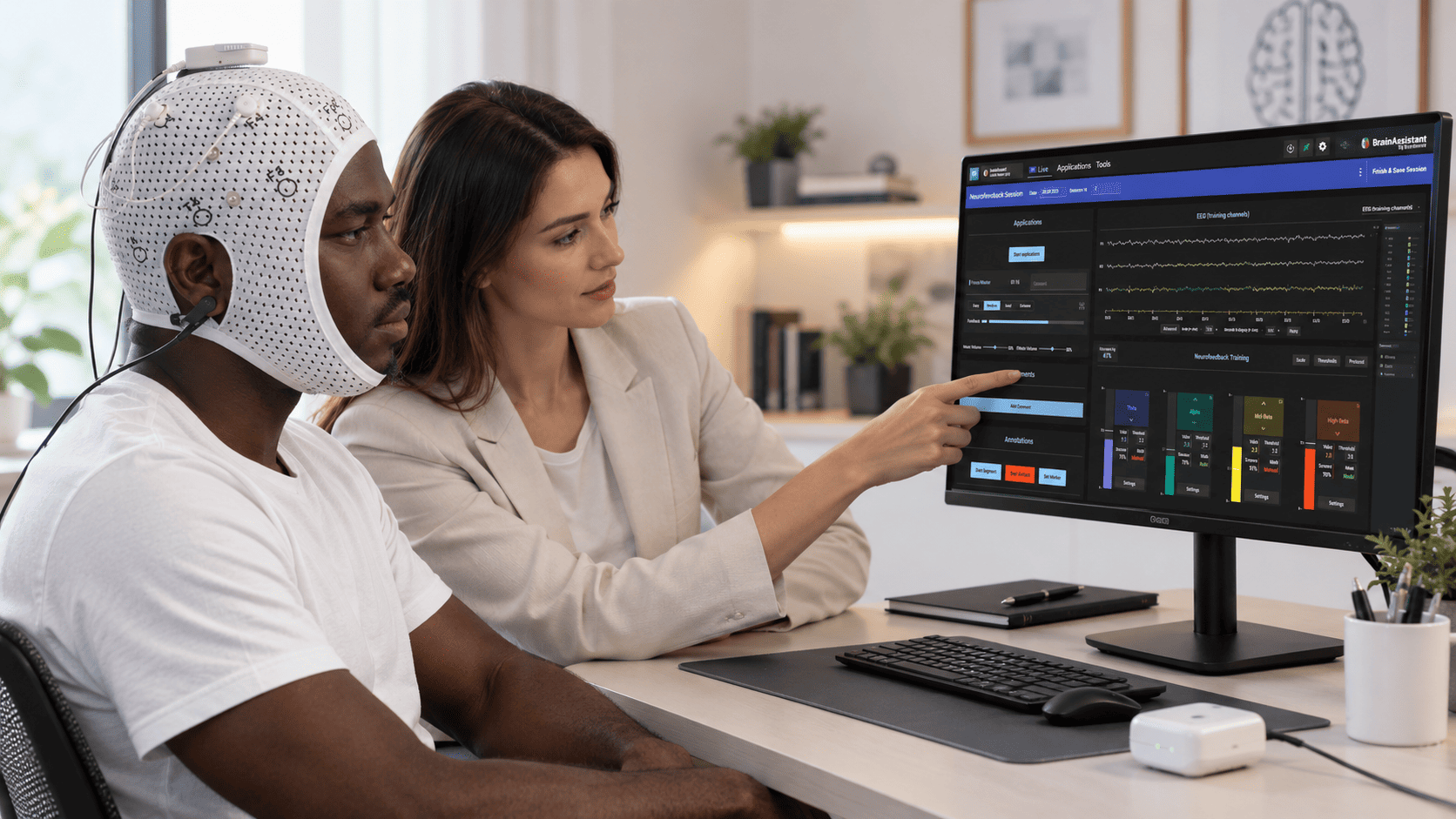
If you are interested in starting neurofeedback training, one of the first practical questions is simple:
What do you actually need for neurofeedback training?
At its core, an EEG-based neurofeedback setup needs a way to record brain activity, software that can process the EEG signal in real time, and a feedback mechanism that allows the user to respond to changes in that activity.
In practice, however, building a reliable neurofeedback setup involves several components working together.
Depending on your goals, you may need:
- an EEG device;
- EEG electrodes or sensors;
- appropriate electrode placement;
- reliable EEG signal acquisition;
- neurofeedback software;
- a computer, tablet, or other compatible device;
- visual, auditory, or game-based feedback;
- a suitable training protocol;
- a comfortable environment with minimal unnecessary interference.
The exact equipment you need depends on what you want to accomplish. A portable setup for personal brain training may look very different from a multi-channel system used by a neurofeedback professional, researcher, developer, or performance coach.
This guide explains the main components of a neurofeedback training setup, why each matters, and what to consider when choosing equipment.
What Is Needed for Neurofeedback Training?
Neurofeedback is based on a feedback loop.
First, EEG sensors record electrical activity from the scalp. The EEG signal is then processed by software, which extracts information about selected patterns of brain activity. That information is translated into feedback the user can see, hear, or otherwise interact with.
A simplified neurofeedback workflow looks like this:
EEG sensors → EEG recording → signal processing → feedback → training
For example, a neurofeedback application might change an animation, adjust music, move an object on a screen, or modify another interactive element according to the EEG features being monitored.
This means a basic EEG neurofeedback system usually requires four fundamental elements:
- EEG hardware
- Electrodes or sensors
- Neurofeedback software
- A feedback interface
But the quality of the experience depends on more than simply having those four pieces.
Signal quality, electrode placement, software compatibility, artifact management, training goals, and the physical environment can all influence the setup.
Let's look at each component.
1. An EEG Device
The EEG device is the foundation of an EEG-based neurofeedback system.
Electroencephalography (EEG) records electrical activity produced by populations of neurons in the brain using electrodes positioned on the scalp.
The EEG hardware receives very small electrical signals from the electrodes, amplifies and digitizes them, and makes the resulting data available to software for processing.
For neurofeedback, the system must be capable of acquiring EEG data with sufficiently low latency for the software to provide meaningful real-time feedback.
Depending on the application, EEG devices can range from compact wearable headbands to flexible electrode systems and multi-channel EEG configurations.
What should you look for in an EEG device for neurofeedback?
Important considerations include:
- number of EEG channels;
- electrode locations;
- sampling rate;
- signal quality;
- wireless or wired connectivity;
- comfort;
- portability;
- software compatibility;
- access to raw EEG data;
- real-time data transmission;
- developer tools or SDK access when needed.
There is no single EEG configuration that is ideal for every neurofeedback application.
The right choice depends primarily on what brain activity you want to monitor and where you need to measure it.
BrainBit explores this decision in more detail in its guide on How to Choose an EEG Device for Neurofeedback.
2. EEG Electrodes or Sensors
An EEG device cannot record brain activity without sensors that establish electrical contact with the scalp.
These sensors are generally referred to as EEG electrodes.
Electrodes detect voltage differences at different scalp locations and send those signals to the EEG acquisition hardware.
Different EEG systems use different electrode technologies and configurations. Depending on the system, electrodes may be integrated into a wearable device or positioned individually at selected locations.
The appropriate solution depends on the application.
For example, a wearable headband with fixed electrode locations can simplify setup and improve consistency when those locations match the needs of the application.
A flexible electrode system may be preferable when the user needs greater control over where electrodes are positioned.
3. Correct EEG Electrode Placement
Having EEG electrodes is only part of the equation.
Where they are placed matters.
Different scalp locations provide access to electrical activity associated with different underlying brain regions and networks. The electrode positions needed for one neurofeedback application may therefore differ from those needed for another.
This is one reason the number of channels alone should not determine which EEG system you choose.
A more useful question is:
Can this EEG configuration record from the locations required for my application?
Some wearable systems provide a small number of predefined electrode locations. Others allow electrodes to be positioned more flexibly.
For applications requiring broader scalp coverage, a multi-channel EEG system may be appropriate.
The key is to match the electrode configuration to the intended neurofeedback protocol, rather than assuming that more channels automatically mean a better neurofeedback experience.
4. Good EEG Signal Quality
Neurofeedback depends on the quality of the signal entering the feedback loop.
EEG signals recorded at the scalp are small and can be affected by many other electrical and physiological sources.
Common sources of unwanted signal include:
- eye blinks;
- eye movements;
- facial muscle activity;
- jaw tension;
- head movement;
- poor electrode contact;
- environmental electrical interference;
- electrode movement.
These unwanted signals are commonly called EEG artifacts.
If a neurofeedback application responds to contaminated data, the feedback may reflect something other than the brain activity the system is intended to monitor.
For example, jaw tension can produce substantial electrical activity from facial muscles. If that activity overlaps with frequencies being analyzed by the software, it can potentially influence the feedback signal.
Good electrode contact, appropriate participant preparation, a suitable recording environment, and real-time signal monitoring can all help improve data quality.
For a deeper explanation, see BrainBit's guide to Common EEG Artifacts Explained.
5. Neurofeedback Software
EEG hardware records the signal.
Neurofeedback software turns that signal into an interactive training experience.
The software receives EEG data and processes selected signal features in real time.
Depending on the application, the software may analyze characteristics such as:
- EEG frequency-band activity;
- relative changes in selected EEG features;
- activity from specific electrode locations;
- relationships between selected signals;
- changes over time.
The software then translates those measurements into feedback.
This feedback needs to happen quickly enough for the user to experience a clear relationship between changes in the EEG signal and changes in the feedback environment.
Software compatibility matters
Before choosing EEG hardware, check whether it works with the software you intend to use.
Likewise, before selecting software, verify which EEG devices it supports.
A powerful EEG device and sophisticated neurofeedback platform are not particularly useful together if they cannot exchange data reliably.
For professionals, developers, and research teams, access to raw EEG data and software development tools can also be important.
6. A Computer, Tablet, or Compatible Device
The neurofeedback software needs somewhere to run.
Depending on the EEG hardware and software, this might be:
- a desktop computer;
- a laptop;
- a tablet;
- a smartphone;
- another compatible computing platform.
The device may perform several jobs simultaneously:
receive EEG data → process the signal → run the neurofeedback application → display the feedback
Hardware requirements vary considerably depending on the software.
A simple visual feedback application may require relatively modest computing resources, while applications involving complex signal processing, advanced visualization, games, data recording, or additional sensors may require more.
Always check the requirements of both the EEG device and neurofeedback software before assembling a system.
7. A Feedback Mechanism
Feedback is what transforms EEG recording into neurofeedback.
Simply displaying raw EEG waves on a monitor does not necessarily create an effective feedback experience.
The system needs to translate selected changes in brain activity into information that the user can understand and respond to.
Feedback can take several forms.
Visual feedback
A visual element might:
- become brighter or darker;
- grow or shrink;
- move across a screen;
- change speed;
- reveal more of an image;
- progress through an animation.
Auditory feedback
The system might modify:
- music volume;
- sound intensity;
- tone;
- background audio;
- other auditory cues.
Game-based feedback
Neurofeedback can also be integrated into games.
For example, EEG activity might affect a character's movement, an object on the screen, progress through a virtual environment, or another part of the game.
Gamification can make repeated training more interactive and engaging.
BrainBit provides examples of this approach through its neurofeedback and biofeedback games, which combine physiological feedback with interactive experiences.
8. A Neurofeedback Protocol
Equipment alone does not determine what the neurofeedback system does.
You also need to define what EEG information will be used for feedback.
This is where the neurofeedback protocol comes in.
A protocol establishes factors such as:
- which EEG channels are monitored;
- which EEG features are analyzed;
- how those features are calculated;
- what thresholds or conditions affect feedback;
- how the feedback changes;
- how sessions are structured.
Without a defined protocol, an EEG system is primarily recording brain activity rather than providing structured neurofeedback training.
The appropriate protocol depends on the application and goals.
For example, a meditation application, cognitive performance application, educational tool, and research experiment may all use EEG differently.
9. Understanding EEG Frequency Bands
Many neurofeedback applications work with EEG activity within different frequency ranges.
Commonly discussed EEG bands include:
- Delta
- Theta
- Alpha
- Beta
- Gamma
These labels describe ranges of oscillatory EEG activity rather than simple switches for particular mental states.
The relationship between EEG frequency and cognition is complex. Brain activity varies according to factors such as location, task, individual differences, environmental conditions, and the way the EEG signal is processed.
For that reason, simplistic claims such as "one brainwave equals focus" should be approached carefully.
Understanding EEG frequency bands is nevertheless useful when designing or evaluating neurofeedback software because many applications calculate feedback using activity within selected frequency ranges.
10. A Suitable Training Environment
A good neurofeedback setup is not only about hardware and software.
The physical environment matters too.
Because EEG can be affected by movement, muscle activity, electrode contact, and electrical interference, the recording environment should support stable EEG acquisition.
Depending on the application, this may involve:
- comfortable seating;
- appropriate monitor placement;
- minimizing unnecessary movement;
- reducing avoidable electrical interference;
- maintaining comfortable room temperature;
- reducing distractions;
- ensuring the EEG device remains correctly positioned.
The goal is not necessarily to create a laboratory-like environment.
Modern wearable EEG systems are designed to make brain monitoring more accessible in real-world settings.
But greater freedom of movement can introduce additional artifacts, so the environment should always reflect the goals of the application.
Do You Need a Professional Neurofeedback System?
Not every neurofeedback setup requires the same equipment.
A useful way to think about neurofeedback technology is to distinguish between the requirements of different use cases rather than searching for one universal "best" system.
Personal and home neurofeedback setups
A personal setup may prioritize:
- simple electrode placement;
- comfortable wearable hardware;
- wireless connectivity;
- fast setup;
- compatible neurofeedback software;
- portability;
- game-based or visual feedback.
A wearable EEG headband can be particularly practical when the electrode locations provided by the device match the intended application.
Professional neurofeedback setups
Professional users may place greater emphasis on:
- flexible EEG configurations;
- reliable repeated setup;
- software compatibility;
- signal-quality monitoring;
- multiple training options;
- data access;
- session management;
- additional electrode positions.
BrainBit's professional neurofeedback solutions are designed around these types of neurofeedback workflows.
Research and development setups
Researchers and developers may require additional capabilities, including:
- access to raw EEG data;
- flexible electrode placement;
- more EEG channels;
- synchronization with external applications;
- real-time data streaming;
- SDK access;
- custom signal processing;
- integration with third-party software.
For these users, the EEG device may be part of a much larger experimental or software ecosystem.
How Many EEG Channels Do You Need for Neurofeedback?
This is one of the most common questions when choosing neurofeedback equipment.
Unfortunately, there is no universal number.
More channels provide access to EEG activity from more scalp locations, but they also increase setup complexity, data volume, and processing requirements.
A smaller wearable EEG configuration may be sufficient when:
- the required electrode locations are available;
- fast setup is important;
- portability matters;
- the application focuses on a limited number of EEG features.
A flexible or multi-channel configuration may be more appropriate when:
- multiple scalp locations must be recorded;
- the project requires broader spatial coverage;
- researchers need greater control over electrode positioning;
- the application involves more complex EEG analysis.
Instead of asking:
How many channels are best for neurofeedback?
ask:
Which EEG locations and signals does my neurofeedback application actually require?
That question usually leads to a much better hardware decision.
Wired vs Wireless EEG for Neurofeedback
Both wired and wireless EEG systems can be used for neurofeedback, depending on the application.
Wireless systems offer obvious advantages for portable setups.
They can reduce cable clutter and provide greater freedom when using EEG outside a traditional workstation.
This can be valuable for:
- interactive neurofeedback;
- meditation;
- educational applications;
- performance training;
- demonstrations;
- portable research;
- neurofeedback games.
However, "wireless" does not automatically mean artifact-free.
Movement, poor electrode contact, muscle activity, and environmental factors can still influence EEG signal quality.
The choice between wired and wireless EEG should therefore be based on the requirements of the complete system rather than connectivity alone.
What BrainBit EEG Device Can Be Used for Neurofeedback?
Different neurofeedback projects have different hardware requirements, which is why BrainBit offers several EEG configurations rather than a single device for every application.
BrainBit Headband
The BrainBit Headband provides a wearable EEG format with predefined electrode locations.
This type of configuration can be useful when portability, comfort, repeatable placement, and relatively simple setup are important.
Potential applications include interactive EEG experiences, neurofeedback, meditation, education, cognitive performance, and software development where the available electrode positions match the project's requirements.
BrainBit Flex
The BrainBit Flex provides greater flexibility in electrode placement.
That can be useful for applications in which predefined headband positions are not sufficient and the user needs greater control over where EEG signals are recorded.
Multi-channel EEG
Projects requiring broader EEG coverage may benefit from a multi-channel acquisition system.
A multi-channel system can provide more spatial information, but it also involves a more complex setup and larger amounts of EEG data.
The appropriate choice should always begin with the application rather than the number printed on the hardware specification sheet.
Can You Build Your Own Neurofeedback Application?
Yes. Neurofeedback does not have to be limited to pre-built software.
Developers can build custom applications that receive EEG data, process selected features, and turn those features into real-time feedback.
A simplified development pipeline might look like:
EEG device → data stream → signal processing → algorithm → application logic → feedback
The application could then provide:
- visual feedback;
- audio feedback;
- games;
- interactive environments;
- performance dashboards;
- custom experimental tasks.
Developers should consider latency, signal quality, artifact handling, data access, operating-system compatibility, and the requirements of the EEG hardware.
BrainBit covers this workflow in more detail in How to Build an EEG Application Using BrainBit SDK.
How Much Does a Neurofeedback Setup Cost?
The cost of a neurofeedback setup varies because a "neurofeedback system" can describe very different combinations of equipment.
Costs may include:
- EEG hardware;
- electrodes and accessories;
- neurofeedback software;
- software subscriptions or licenses;
- computer hardware;
- additional displays;
- training applications;
- replacement components;
- developer tools or integrations.
A portable personal setup and a multi-channel professional or research system should therefore not be expected to have the same price.
Rather than evaluating price alone, consider the total setup required for the intended workflow.
An inexpensive EEG device that cannot connect to the software or provide the electrode positions your application requires may ultimately be less useful than a system selected around your actual requirements.
For a more detailed breakdown, see BrainBit's guide on How Much Does a Neurofeedback System Cost?
How to Choose a Neurofeedback Setup
Before buying neurofeedback equipment, define what you actually want the system to do.
Start with these questions:
1. What is the purpose of the training?
Are you building a meditation experience, cognitive performance tool, neurofeedback game, educational application, professional setup, or research project?
2. Which EEG locations do you need?
This determines whether fixed electrode positions are sufficient or flexible placement is required.
3. How many EEG channels are necessary?
Choose based on the signal requirements rather than assuming more channels are always better.
4. Will the user move during training?
Movement influences hardware design, electrode stability, and artifact management.
5. Which neurofeedback software will you use?
Check compatibility before purchasing hardware.
6. Do you need access to raw EEG data?
This can be especially important for researchers and developers.
7. Do you need an SDK?
If you plan to build custom software, real-time data access and developer documentation may be essential.
8. Where will the system be used?
A permanent workstation and a portable home or performance setup have different requirements.
9. What type of feedback will you provide?
Consider whether the experience will use visual feedback, audio, games, or a custom interface.
Answering these questions before choosing equipment can prevent many compatibility and workflow problems later.
A Basic Neurofeedback Equipment Checklist
For most EEG-based neurofeedback projects, the basic checklist looks like this:
| Component | Why you need it |
| EEG device | Records electrical brain activity |
| EEG electrodes | Establish contact with the scalp |
| Appropriate electrode placement | Captures EEG from the locations required by the application |
| Signal acquisition | Digitizes and transmits EEG data |
| Neurofeedback software | Processes EEG and determines feedback |
| Computer/mobile device | Runs the software and feedback application |
| Feedback interface | Gives the user real-time information |
| Training protocol | Defines what EEG activity affects feedback |
| Signal-quality monitoring | Helps identify artifacts and poor electrode contact |
| Suitable environment | Supports stable, repeatable EEG recording |
Not every neurofeedback setup needs additional equipment beyond these fundamentals.
The important point is that the components must work as a system.
Frequently Asked Questions
What equipment do you need for neurofeedback training?
A typical EEG neurofeedback setup includes an EEG device, scalp electrodes or sensors, signal acquisition hardware, neurofeedback software, a compatible computer or mobile device, and a visual, auditory, or game-based feedback mechanism. The exact configuration depends on the application and the EEG locations that need to be recorded.
Do you need EEG for neurofeedback?
EEG is used for brainwave-based neurofeedback because it provides a way to record electrical brain activity from the scalp in real time. Other forms of biofeedback can use different physiological signals, but EEG-based neurofeedback specifically relies on brain activity.
What type of EEG device is used for neurofeedback?
Wearable headbands, flexible electrode systems, and multi-channel EEG devices can all be used depending on the application. Important considerations include electrode placement, channel count, signal quality, data access, software compatibility, and portability.
How many EEG channels do you need for neurofeedback?
There is no universal number of channels required for every neurofeedback application. The appropriate number depends on which scalp locations and EEG features the application needs to monitor. Some applications can work with a small number of channels, while others require broader coverage.
What software do you need for neurofeedback?
You need software capable of receiving EEG data, processing the relevant signal features in real time, and translating those features into feedback. Compatibility between the EEG hardware and neurofeedback software should be confirmed before building a setup.
Can wearable EEG be used for neurofeedback?
Yes. Wearable EEG devices can support neurofeedback applications when their electrode locations, signal characteristics, data access, and software compatibility match the application's requirements. Wearable systems can also simplify setup and improve portability.
Can you do neurofeedback training at home?
Portable EEG and compatible software have made home-based neurofeedback technically possible for some non-clinical applications. The appropriate setup depends on the user's goals, equipment, software, protocol, and ability to maintain reliable EEG signal quality.
Can neurofeedback use games?
Yes. EEG features can be translated into changes within an interactive game, such as movement, visual effects, audio, or progress. Game-based feedback can make repeated neurofeedback sessions more interactive and engaging.
How much does neurofeedback equipment cost?
Costs vary according to EEG channel count, electrode configuration, software, accessories, and intended application. A compact wearable setup can have very different requirements from a flexible professional, development, or multi-channel research configuration.
What should you look for when choosing neurofeedback equipment?
Start with the application. Consider which EEG locations are required, channel count, signal quality, electrode design, comfort, wired or wireless connectivity, software compatibility, raw data access, portability, and whether SDK support is necessary.
Final Thoughts: Building the Right Neurofeedback Setup
So, what do you need for neurofeedback training?
The short answer is:
an EEG device + electrodes + reliable signal acquisition + neurofeedback software + real-time feedback + an appropriate training protocol.
The longer and more important answer is that these components need to be selected as part of a complete system.
The best EEG hardware is not necessarily the device with the largest number of channels. The best software is not necessarily the platform with the longest feature list.
What matters is whether the hardware, electrode configuration, signal processing, software, and feedback mechanism fit the intended application.
For a portable neurofeedback experience, comfort, wireless connectivity, and simple electrode placement may be priorities. For custom applications, raw EEG access and SDK compatibility may matter more. For professional or research workflows, flexible electrode placement and additional channels may become important.
Starting with the application and then selecting the technology is usually more effective than starting with a piece of hardware and trying to design the application around it.
BrainBit's wearable and flexible EEG technologies are designed to support a range of non-clinical neurofeedback, research, education, meditation, cognitive performance, and neurotechnology development applications.