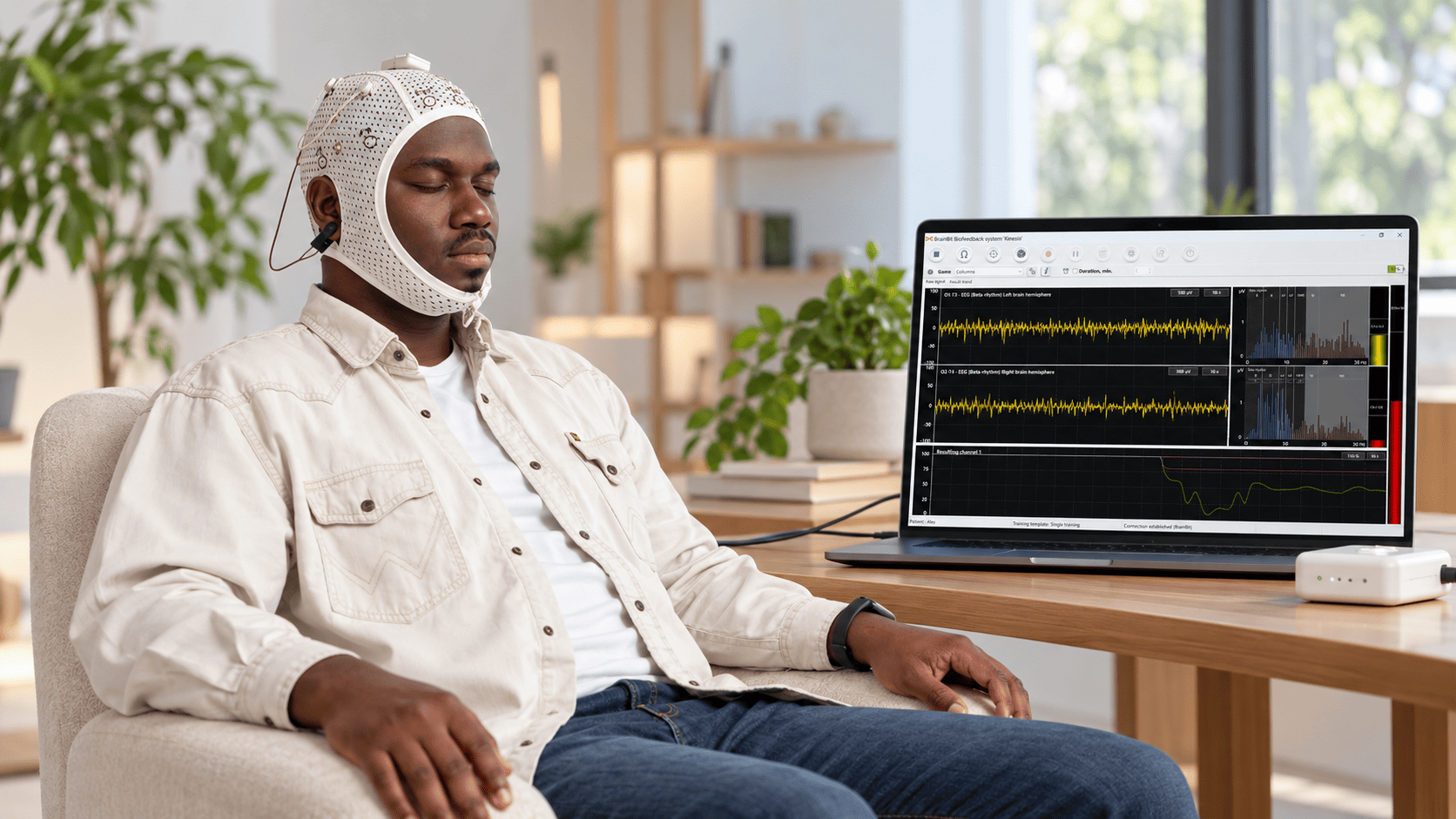
EEG neurofeedback software is an essential component of any brainwave-based feedback system. While EEG hardware captures electrical activity from the scalp, software transforms those recordings into meaningful information and interactive feedback that users can engage with in real time.
But not all neurofeedback platforms offer the same capabilities.
Some prioritize straightforward visual or auditory feedback. Others provide advanced EEG monitoring, configurable training environments, session tracking, or integration with multiple hardware configurations. Developer-oriented solutions may offer access to raw EEG data, APIs, and software development kits (SDKs) for creating entirely new applications.
Choosing the right EEG neurofeedback software therefore involves more than comparing interfaces or feature lists. You also need to consider EEG device compatibility, signal quality, real-time processing, feedback options, data accessibility, and the requirements of your intended application.
For professionals, the software should support a reliable and practical workflow. For developers, integration flexibility may be the deciding factor. For organizations building meditation, cognitive performance, or interactive brain-training experiences, usability and scalability can be equally important.
This guide explains how EEG neurofeedback software works, which features deserve attention, and how to evaluate a platform that fits your hardware, users, and long-term goals.
What Is EEG Neurofeedback Software?
EEG neurofeedback software is a platform that receives brainwave data from an EEG device, processes selected characteristics of that activity, and converts them into real-time feedback.
The process begins with electroencephalography (EEG), a technology that records electrical activity through electrodes positioned on the scalp.
An EEG acquisition device amplifies and digitizes these small electrical signals. The resulting data can then be transmitted to compatible software for visualization, processing, recording, or interactive applications.
Neurofeedback software builds on this process by connecting selected EEG measurements to a feedback mechanism.
For example, a platform might analyze changes in activity within a specified EEG frequency range and use that information to modify an animation, sound, or game element.
The user experiences changes in the feedback environment as the monitored EEG characteristics change.
This creates a continuous interaction between recorded brain activity and the software.
How EEG neurofeedback software differs from EEG recording software
Although the two categories share some underlying technologies, their primary purposes are different.
EEG recording software focuses on acquiring, displaying, storing, and analyzing EEG signals.
Neurofeedback software uses EEG information to drive an interactive feedback experience.
Some platforms combine both functions, while others specialize in one.
Feature |
EEG recording software |
EEG neurofeedback software |
| EEG signal acquisition | Yes | Typically |
| Live EEG visualization | Common | Common, but implementation varies |
| Data recording | Common | Platform-dependent |
| Signal processing | Yes | Yes |
| Real-time interactive feedback | Not necessarily | Core functionality |
| Visual or auditory training | Not necessarily | Common |
| Game-based feedback | Not necessarily | Available on some platforms |
| Session management | Application-dependent | Available on some platforms |
The distinction matters when selecting a system.
An EEG application that displays brainwave activity is not automatically a complete neurofeedback platform. Likewise, a simple neurofeedback application may not provide the advanced recording or analysis features required for research.
The right choice depends on the workflow you want to support.
How Does EEG Neurofeedback Software Work?
Understanding the basic software workflow makes it easier to compare platforms and identify which capabilities matter most.
A typical EEG neurofeedback system follows several stages.
1. EEG signal acquisition
EEG electrodes detect electrical potential differences at the scalp.
These signals are transmitted to EEG acquisition hardware, which amplifies and digitizes the recordings.
The quality of the original signal depends on several factors, including electrode contact, positioning, environmental conditions, and the acquisition system.
2. Data transmission
The EEG device sends recorded data to a compatible computer, mobile device, or other processing platform.
Depending on the hardware, this connection may be wired or wireless.
For wireless EEG systems, the software must support the device's communication method and data format.
Reliable data transmission is especially important for applications that depend on continuous feedback.
3. Signal processing
Once the EEG data reaches the software, processing algorithms extract the information needed for the application.
Processing may include filtering, segmentation, frequency analysis, and identification of selected signal features.
Some applications analyze activity within familiar EEG frequency ranges, including alpha, beta, and theta.
However, these frequency bands should not be interpreted as simple one-to-one indicators of specific mental states. Their meaning depends on recording conditions, electrode locations, the task being performed, and the analysis method.
4. Feedback generation
The software translates the selected EEG measurements into feedback.
For example, changes in a monitored EEG feature may influence the movement of an object, the brightness of a visual scene, or the volume of a sound.
The exact relationship between EEG activity and feedback depends on the application's design.
5. Continuous interaction
The software repeatedly receives EEG data, updates its calculations, and adjusts the feedback.
This ongoing process is what distinguishes real-time neurofeedback from simply reviewing EEG recordings after a session.
For an effective technical implementation, the complete system must support sufficiently timely and stable feedback.
That includes not only the software but also the EEG hardware, communication connection, signal-processing pipeline, and feedback interface.
Key Features to Look for in EEG Neurofeedback Software
There is no universal feature set that makes one platform the best choice for every application.
Nevertheless, several capabilities are particularly important when evaluating EEG-compatible neurofeedback software.
1. EEG Device Compatibility
Compatibility should be one of the first things you verify.
Not every EEG device works with every neurofeedback platform.
Different manufacturers may use different communication protocols, data structures, drivers, electrode configurations, or integration methods.
Before choosing software, determine which EEG devices it officially supports.
Important questions include:
- Does the platform support your specific EEG device and hardware version?
- Is the connection wired or wireless?
- Which operating systems are supported?
- Can the software access the EEG channels required for your application?
- Does it support real-time EEG data streaming?
- Are device drivers or additional integrations required?
- Is the software maintained for current hardware and operating-system versions?
Compatibility is particularly important for organizations using multiple EEG configurations.
For example, a compact wearable headband may provide a small number of predefined recording locations, while a flexible electrode system can support different placement requirements.
Software designed around one configuration may not automatically accommodate another.
Why hardware compatibility matters
Consider a performance-training application that uses a wearable EEG headband.
The software must be able to receive data from the headband, identify the relevant EEG channels, process the incoming signal, and generate feedback.
If any part of that workflow is unsupported, the application may not function as intended.
This is why hardware and software should be evaluated together rather than purchased independently.
BrainBit offers EEG hardware configurations such as the BrainBit Headband, which can serve as a hardware component in compatible wearable EEG applications.
The important consideration is whether the device's electrode positions, data access, and supported integration methods match the software requirements.
2. Real-Time EEG Processing
Real-time processing is a defining characteristic of neurofeedback software.
The system needs to analyze incoming EEG data and update the feedback without unnecessary delays.
This introduces several technical considerations.
Data acquisition rate
The EEG sampling rate determines how frequently the signal is digitized.
A suitable sampling rate depends on the EEG features being analyzed and the requirements of the application.
A higher sampling rate is not automatically better for every neurofeedback use case. It can also increase data volume and processing demands.
Processing latency
Latency refers to the time between the acquisition of EEG information and its effect on the feedback interface.
The total delay may include data acquisition, transmission, buffering, filtering, feature extraction, and application rendering.
For interactive applications, developers should evaluate end-to-end feedback latency, rather than relying on a single hardware specification.
Processing stability
Software should be able to handle continuous data streams without frequent interruptions, unexpected processing delays, or loss of synchronization.
This is especially relevant for longer sessions and applications involving multiple data streams.
When evaluating EEG neurofeedback software, ask whether the platform provides information about its processing capabilities and any limitations that could affect your intended workflow.
3. EEG Signal Quality Monitoring
EEG is sensitive to electrical activity that does not originate from the brain.
These unwanted contributions are commonly described as EEG artifacts.
Typical sources include eye movements, blinking, facial muscle activity, jaw tension, head movement, poor electrode contact, and environmental electrical interference.
For neurofeedback applications, signal quality matters because artifacts can influence the measurements used to generate feedback.
For example, an application that monitors activity within a particular frequency range may also capture unwanted muscle-related activity that overlaps with that range.
If the software does not account for signal contamination, feedback may be affected by activity unrelated to the intended EEG feature.
What to look for
Useful software capabilities may include live EEG visualization, electrode contact indicators where supported by the hardware, artifact monitoring, and mechanisms for handling unreliable signal segments.
Some platforms may also offer configurable filters or additional signal-quality controls.
The availability and effectiveness of these features vary between systems.
It is important to distinguish between detecting possible artifacts and reliably removing them. No single artifact-handling method can guarantee that every EEG recording is free from contamination.
4. Visual, Auditory, and Game-Based Feedback
The feedback interface determines how users interact with the EEG information.
Different applications benefit from different feedback formats.
Visual neurofeedback
Visual feedback may use changing shapes, animations, progress indicators, or interactive environments.
For example, the software might modify the brightness of a scene or the movement of an object based on selected EEG measurements.
Visual feedback is useful when an application requires a clear, continuously updated representation of the monitored signal.
Auditory neurofeedback
Auditory feedback uses sound to communicate changes in EEG activity.
A platform might adjust music volume, tone, or another sound characteristic.
This approach can be appropriate when users are not expected to focus on a screen throughout the experience.
Game-based neurofeedback
Game-based feedback integrates EEG measurements into interactive environments.
Instead of observing a traditional feedback indicator, users may interact with a game whose elements respond to the EEG data.
Examples can include movement, progress, animation changes, or other gameplay mechanics.
Gamification may help make repeated sessions more engaging, although engagement should not be confused with evidence of a particular training outcome.
BrainBit's neurofeedback and biofeedback games demonstrate how physiological feedback can be incorporated into interactive software experiences.
When comparing platforms, consider whether their feedback formats suit your audience and whether the feedback behavior can be configured for the intended application.
5. Session Tracking and Data Visualization
For professionals and organizations running repeated neurofeedback sessions, data management can be an important software requirement.
A platform may provide tools for organizing sessions, reviewing selected EEG measurements, and observing changes across recordings.
Potential features include session histories, configurable dashboards, graphical displays, data export, and annotations.
These capabilities can support more consistent workflows and make it easier to review how the system performed during individual sessions.
However, it is important to distinguish between different types of information.
A change in a displayed EEG metric does not, by itself, establish an improvement in attention, performance, or another real-world outcome.
EEG measurements can be influenced by recording conditions, artifacts, individual variability, and analysis choices.
For that reason, software metrics should be interpreted within the context of the application and the data being collected.
Data export and accessibility
If you plan to conduct independent analysis, data export may be essential.
Check whether the platform allows access to recorded EEG data, which file formats it supports, and whether exported recordings include relevant metadata.
For organizations integrating neurofeedback into broader technology workflows, accessible data can be just as important as the interface used during a session.
6. User Experience and Workflow Design
Advanced functionality is valuable only when the intended users can operate the software effectively.
A platform designed for EEG researchers may prioritize detailed signal controls and flexible data analysis.
A platform intended for guided training may place greater emphasis on simple navigation, clear feedback, and consistent session setup.
Neither approach is inherently better.
The appropriate interface depends on who will use the software and what they need to accomplish.
When evaluating usability, consider the complete workflow:
How easy is it to connect the EEG device? Can the user confirm that data is being received? Is signal quality visible? Are feedback settings easy to locate? Can sessions be started, paused, and reviewed without unnecessary complexity?
A clear interface can reduce setup friction and help users focus on the intended experience.
For professional environments, it may also be useful to assess how easily the software supports repeated sessions and different equipment configurations.
7. Software Updates, Documentation, and Support
Neurofeedback software is part of a larger technical ecosystem.
Operating systems change, hardware firmware evolves, and new application requirements emerge.
For this reason, long-term compatibility deserves attention.
Before selecting a platform, investigate its documentation, supported hardware versions, update practices, and available technical support.
For developer-oriented tools, documentation quality can have a direct effect on implementation time.
Useful documentation should explain how to connect to supported EEG devices, access data, manage streaming sessions, and work with the relevant software interfaces.
If your organization is planning a long-term neurotechnology product, consider not only what the software supports today but also how maintainable the integration is likely to be.
Professional vs Personal Neurofeedback Software
The differences between professional and personal neurofeedback applications are often related to workflow complexity rather than one universal technical standard.
Personal and guided-use applications
Personal applications may prioritize portability, comfortable hardware, simple interfaces, and intuitive feedback.
A meditation-oriented application, for example, may use a wearable EEG device and a mobile interface to provide an interactive experience.
The user may not need direct access to every processing parameter or a detailed EEG analysis dashboard.
Professional applications
Professional neurofeedback environments may require additional flexibility.
Depending on the workflow, users may need more detailed EEG monitoring, configurable feedback options, session organization, or compatibility with particular electrode configurations.
Organizations should evaluate whether a platform supports the requirements of their specific applications rather than assuming that a product labeled professional automatically includes every advanced feature.
BrainBit's professional neurofeedback solutions provide a relevant starting point for exploring how EEG hardware and compatible software can be combined in professional workflows.
Research and development applications
Research teams and developers may prioritize access to raw EEG data, control over processing methods, and integration with external applications.
For these users, the ability to build or modify the software workflow may be more important than access to a preconfigured feedback experience.
This leads to another important decision: whether to use ready-made neurofeedback software or develop a custom application.
Ready-Made Neurofeedback Software vs Custom Development
Not every organization needs to develop its own EEG neurofeedback software.
Ready-made platforms can provide an established interface and an existing set of feedback and session-management functions.
Custom development offers greater control but requires additional technical resources.
Consideration |
Ready-made software |
Custom EEG application |
| Initial implementation | Often faster | Requires development |
| Feedback interface | Existing options | Customizable |
| Signal processing | Platform-defined or configurable | Developer-controlled |
| EEG compatibility | Limited to supported devices | Depends on SDK and integration |
| Branding | Platform-dependent | Greater control |
| Maintenance | Primarily platform provider | Development team |
| Integration flexibility | Depends on available interfaces | Potentially extensive |
| Technical expertise | Varies | Typically higher |
When ready-made software makes sense
An existing platform may be a practical choice when its supported EEG devices, feedback options, and data-management capabilities already meet the application's requirements.
This can reduce the amount of custom development needed.
However, compatibility and available functionality should be verified before committing to a platform.
When custom development makes sense
Custom development becomes more relevant when an organization wants to create a differentiated experience.
Examples include meditation applications, interactive performance-training tools, educational software, EEG-driven games, and research applications.
These projects may require custom interfaces, specialized processing, integration with other technologies, or unique feedback mechanisms.
In such cases, the EEG hardware and its developer tools become central to the software architecture.
The Role of EEG SDKs in Neurofeedback Software Development
A software development kit, or SDK, provides tools that help developers integrate supported technology into their applications.
In an EEG ecosystem, an SDK may expose functionality such as device connectivity, EEG data acquisition, and access to recorded or streamed data.
The exact capabilities depend on the hardware manufacturer and SDK.
For neurofeedback development, SDK access can make it possible to build a custom pipeline:
EEG acquisition → data processing → feature extraction → feedback logic → user interface
Developers can then design the application around their own requirements.
For example, a custom meditation application might use selected EEG measurements to control an audio or visual experience.
An educational application could use EEG information within an interactive learning environment.
A research application might combine EEG recording with experimental tasks and independent analysis.
These examples illustrate potential architectures rather than features guaranteed by every SDK.
BrainBit provides developer resources through the BrainBit SDK, supporting the development of applications built around compatible BrainBit EEG technology.
Before beginning development, teams should verify supported devices, operating systems, data access, documentation, and licensing requirements.
What developers should evaluate
Beyond basic device connectivity, developers should consider the quality and completeness of the integration tools.
Questions worth investigating include whether the SDK provides continuous data streaming, how device connection events are handled, whether data timestamps are available, and what happens when connectivity is interrupted.
The application must also account for buffering, signal processing, feedback updates, and error handling.
An SDK simplifies access to hardware functionality, but it does not automatically provide a complete neurofeedback application.
The feedback algorithm, interface, and broader software experience still need to be designed and validated for the intended use case.
How BrainBit Fits Into an EEG Neurofeedback Software Ecosystem
A neurofeedback application depends on cooperation between hardware and software.
BrainBit's role in this ecosystem includes wearable EEG hardware, flexible electrode configurations, and developer-oriented technology that can support different application architectures.
The BrainBit Headband provides a wearable EEG format with predefined electrode locations.
This can be useful when portability, consistent placement, and relatively straightforward setup are important, provided the electrode positions meet the application's needs.
BrainBit Flex offers a different hardware approach for projects requiring greater flexibility in electrode placement.
For developers, the BrainBit SDK provides an integration pathway for building applications around supported hardware.
BrainBit also presents professional neurofeedback solutions and examples of EEG-based applications within its broader ecosystem.
The important distinction is that EEG hardware, neurofeedback software, and the application experience are separate but connected components.
A wearable EEG device does not automatically include every software function described in this guide. Similarly, the availability of an SDK does not mean that every third-party platform is compatible without additional development.
Choosing the right combination begins with defining the application and verifying the capabilities of each component.
How to Choose EEG Neurofeedback Software: A Practical Checklist
Before committing to a platform, it helps to evaluate your requirements systematically.
The following checklist can support a software comparison.
Evaluation area |
Questions to ask |
| Intended application | What type of neurofeedback experience are you building or delivering? |
| EEG hardware | Which devices and hardware versions are supported? |
| Electrode configuration | Can the software use the required EEG channels? |
| Data access | Is real-time EEG streaming available? |
| Processing | Which signal-processing features are supported? |
| Signal quality | How can users identify unreliable recordings? |
| Feedback | Are visual, auditory, or game-based options available? |
| Latency | Is the complete feedback loop responsive enough for the application? |
| Session management | Can sessions be organized, reviewed, or exported as needed? |
| User experience | Does the interface fit the intended users? |
| Integration | Are APIs, SDKs, or other developer tools available? |
| Compatibility | Which operating systems and devices are supported? |
| Maintenance | What documentation, updates, and support are provided? |
| Data handling | How are recordings stored, exported, and protected? |
| Cost | What hardware, licensing, subscription, or development costs apply? |
Not every category will carry equal weight.
For a portable meditation application, ease of use and wearable hardware compatibility may be particularly important.
For a professional workstation, signal monitoring and workflow management may deserve greater attention.
For a custom EEG application, access to data and development tools may be decisive.
The goal is to choose software that meets the actual requirements of the project rather than simply selecting the platform with the longest feature list.
Common Mistakes When Choosing Neurofeedback Software
Several avoidable mistakes can make an otherwise promising EEG setup difficult to use.
Choosing software before checking hardware compatibility
A platform may offer appealing feedback features but lack support for the EEG device you intend to use.
Always confirm compatibility early in the evaluation process.
Focusing only on the user interface
An attractive interface cannot compensate for unreliable EEG acquisition or unsupported data processing.
The underlying technical workflow matters just as much as the visible experience.
Assuming all EEG software provides neurofeedback
EEG recording, analysis, visualization, and neurofeedback are related but distinct capabilities.
Verify that the software provides the specific real-time feedback functionality your application requires.
Overlooking signal quality
EEG artifacts can influence the measurements used by the feedback system.
A platform should provide an appropriate way to monitor or manage signal reliability within its intended workflow.
Ignoring long-term integration needs
A solution that works for an initial demonstration may not meet future requirements for additional hardware, data access, customization, or application maintenance.
Consider the likely direction of the project before selecting the software architecture.
Frequently Asked Questions About EEG Neurofeedback Software
What is EEG neurofeedback software?
EEG neurofeedback software receives data from a compatible EEG device, processes selected features of brain activity, and translates those measurements into real-time visual, auditory, or interactive feedback.
Does neurofeedback software work with any EEG device?
No. Compatibility depends on the platform and the EEG hardware. Different devices use different communication methods, data formats, electrode configurations, and integration tools. Always verify supported devices before choosing software.
What is the difference between EEG software and neurofeedback software?
EEG software is a broad category that includes recording, visualization, and analysis tools. Neurofeedback software specifically uses EEG measurements to generate real-time feedback. Some platforms combine these capabilities.
What features should neurofeedback software have?
Important features may include EEG hardware compatibility, real-time processing, signal-quality monitoring, suitable feedback options, session tracking, data access, and a usable interface. The exact requirements depend on the application.
Can neurofeedback software use games?
Yes. Some neurofeedback applications translate selected EEG measurements into changes within interactive games. Game-based feedback can provide an engaging way to interact with brainwave information.
Can wearable EEG devices work with neurofeedback software?
Yes, provided the software supports the device and the hardware configuration meets the application's requirements. Wearable EEG can be useful for portable, interactive, and non-laboratory applications.
Do you need an SDK to use neurofeedback software?
Not necessarily. Ready-made software may already support the required EEG device. An SDK becomes more important when developers want to create custom applications or integrate EEG data into their own software.
Can you build custom EEG neurofeedback software?
Yes. With compatible EEG hardware, appropriate data access, and development tools, developers can create custom applications that process EEG information and generate interactive feedback.
Is professional neurofeedback software different from personal software?
Professional and personal platforms may differ in interface complexity, configuration options, session management, hardware support, and data access. The distinction depends on the product and its intended workflow.
How do you choose the right EEG neurofeedback software?
Begin by defining the intended application. Then evaluate EEG device compatibility, required electrode locations, signal processing, feedback formats, data access, user experience, technical support, and total implementation requirements.
Final Thoughts: Choosing the Right EEG-Compatible Neurofeedback Platform
Selecting EEG neurofeedback software is not simply a matter of finding a platform that displays brainwaves or offers an appealing feedback interface.
The most important question is whether the software can reliably support the complete workflow required by your application.
That includes acquiring EEG data from compatible hardware, processing the signal, managing recording quality, and translating selected measurements into meaningful real-time feedback.
For professionals, the priority may be dependable operation, clear monitoring, and practical session management.
For developers, access to EEG data, SDK capabilities, and integration flexibility may be more important.
For organizations creating meditation, educational, performance, or interactive applications, the right combination of wearable EEG technology and software design can open opportunities for differentiated user experiences.
Ultimately, the strongest neurofeedback setup is not defined by hardware or software alone. It is defined by how effectively the components work together.
BrainBit's EEG hardware, developer tools, and professional solution ecosystem provide different starting points for exploring and building EEG-based neurofeedback applications.
By choosing technology around clearly defined requirements, organizations can create systems that are technically appropriate, maintainable, and aligned with their intended users.