Why Focus on the Younger Generation for Brain Training
The developing brain is a precious and powerful time, full of immense potential and helping to shape many of the neural circuits that support learning, behaviour, and cognition throughout life.
During development (especially between 0–10 years of age), the brain contains more synaptic connections than it will at any other point in life [1]. Synaptic connections are the points of communication between neurons. Together, connected neurons form circuits that work together to perform specific functions.
The brain's ability to change and strengthen these connections is what we call neuroplasticity. While we maintain this ability throughout our entire lives, it is especially active during development because the brain is rapidly forming and refining these neural connections [2].
Throughout childhood and adolescence, the brain is constantly wiring and strengthening circuits involved in:
- Attention and focus
- Identity and core values
- Cognition and memory
- Emotional regulation
- Decision-making
Interestingly, the prefrontal cortex, the region at the front of the brain responsible for many executive functions, is one of the last brain regions to fully mature. Throughout childhood and into early adulthood, the brain undergoes synaptic pruning, a natural process that helps refine neural networks by strengthening frequently used connections while reducing less active ones. This allows the brain to become more efficient as it develops [3].
This remarkable period of development raises an exciting question:
What if there were ways to intentionally support healthy brain development during this highly plastic stage of life, helping build a strong foundation for learning and self-regulation?
Enhancing Development Through Cognitive Training in Disguise
One approach that has been explored to support the development of executive functions is cognitive training [4]. Through repeated practice, the neural circuits involved in these skills are repeatedly activated, helping strengthen those connections through neuroplasticity.
Cognitive training has shown promising results, although its effectiveness can vary depending on factors such as age, socioeconomic status, and conditions like attention deficit hyperactivity disorder (ADHD) or other learning disabilities [5].
One major challenge, however, is consistency. Like learning to play an instrument or developing a new sport, strengthening the brain requires repeated practice over time. If these exercises are not performed consistently, it becomes much more difficult to strengthen the desired neural circuits.
This is where gamification comes into play.
Creating games with engaging characters, levels, challenges, and rewards doesn't just encourage kids and young adults to keep learning, it also makes the learning process itself more engaging. Good games naturally provide immediate feedback, clear goals, and a sense of progress, all of which help maintain motivation over time [6].
Researchers believe these game elements engage brain networks involved in reward, motivation, and reinforcement learning. As players overcome new challenges and make progress, they are more likely to stay engaged and continue practising, an essential ingredient for neuroplasticity and long-term learning [7].
While cognitive training may help strengthen important brain functions, an important question remains:
How do we know whether the brain is actually learning the patterns of activity we are trying to encourage?
Training the Brain Through Real-Time Feedback
This is where neurofeedback offers a unique advantage.
Neurofeedback uses electroencephalography (EEG) to record the brain's electrical activity and provide real-time feedback to the user. EEG measures brainwave activity generated by large groups of neurons working together across different areas of the brain.
Different neurofeedback protocols are designed to reinforce patterns of brain activity that have been associated with skills such as sustained attention or relaxation [8].
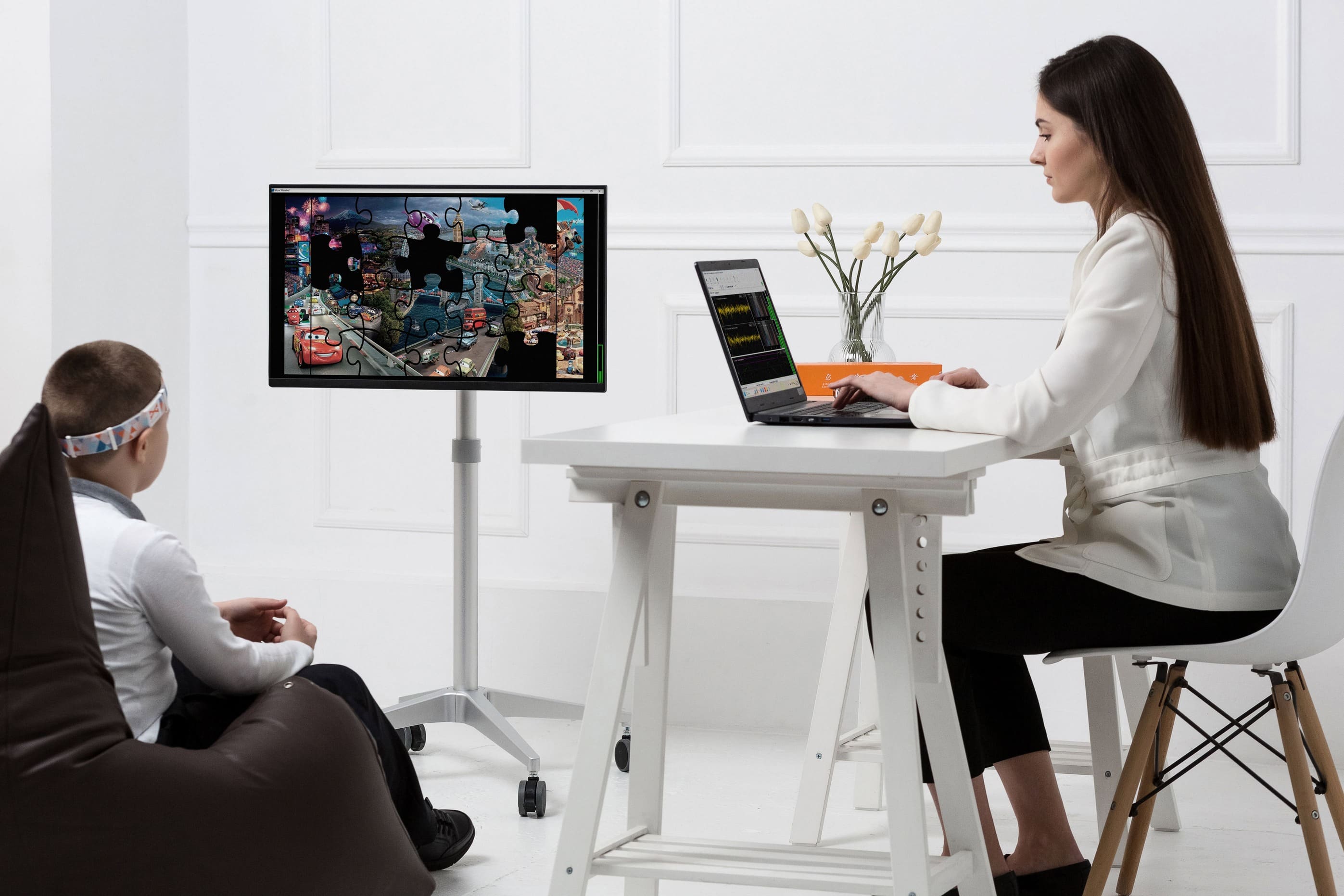
For example, a neurofeedback game may become brighter, the music may become louder, or a character may move forward when the user's brain activity shifts toward the desired pattern. When brain activity moves away from that target, the feedback changes accordingly. This allows users to observe and gradually learn to regulate their own brain activity through repeated practice and immediate feedback.
Similar to gamification, neurofeedback uses positive reinforcement to encourage learning. By providing immediate feedback on the brain's activity, users receive a rewarding sense of progress that can help improve engagement and motivation throughout training.
Neurofeedback has been studied for several decades and has been investigated as a complementary approach for supporting attention, learning, and self-regulation in conditions such as ADHD, learning disabilities, and more recently, autism spectrum disorder [9].
With the emergence of consumer-grade EEG devices, neurofeedback has become more affordable and practical to use at home. As research on home-based neurofeedback continues to grow, it may offer an accessible way to increase training consistency which is an important factor in promoting meaningful and lasting improvements [10].
Personalized Brain Training Games for Younger Generations
This is where we can begin to combine the best of both worlds: personalized neurofeedback and cognitive training games.
By combining real-time neurofeedback with engaging cognitive exercises, users can practise important mental skills while simultaneously receiving feedback about their own brain activity. This creates a highly interactive training experience that is both engaging and personalized.
Researchers have already begun exploring this combination. One study involving children between the ages of 3 and 6 found that combining neurofeedback with cognitive training games led to greater improvements in learning scores than either neurofeedback or cognitive training alone [11].
Moreover, even more customized neurofeedback games may soon emerge, including games designed to support social interaction and engagement for children on the autism spectrum [12].
As wearable EEG technology continues to become more accessible, these personalized approaches to brain training may become increasingly available both in research settings and at home.
BrainBit is one example of this growing trend toward accessible neurotechnology. Through compatible EEG devices, users can explore a collection of neurofeedback games designed to make brain training more engaging while providing real-time feedback about their brain activity. By combining portable EEG technology with interactive games, these tools aim to make regular brain training both accessible and enjoyable.
For younger generations growing up surrounded by technology, the question may not be whether screens influence the brain—they already do. The more important question is: Can we design digital experiences that intentionally support healthy brain development?
By helping children interact with their own brain activity in fun and engaging ways, technology has the potential to become more than entertainment. It may become a valuable tool for supporting attention, self-regulation, and lifelong learning.
From a broader perspective, neurofeedback games represent an exciting evolution of digital learning. Rather than using games solely for entertainment, they combine engaging game mechanics with real-time EEG feedback to encourage active participation, motivation, and repeated practice - three important ingredients for learning and neuroplasticity. As research in this area continues to grow, neurofeedback games may become an increasingly valuable tool for education, cognitive training, and professional neurofeedback, helping transform screen time into a more purposeful and interactive experience.
About the Author
Sylvie Lahaie is a McGill-trained PhD in neuroscience and a neurofeedback practitioner based in Montreal. She works in remote neurofeedback, specializing in meditation and brain self-regulation, bridging neuroscience research with practical tools for everyday mental well-being.
www.synapticsylvie.com
References
1 - Gilmore, J. H., Knickmeyer, R. C., & Gao, W. (2018). Imaging structural and functional brain development in early childhood. Nature Reviews. Neuroscience, 19(3), 123–137. https://doi.org/10.1038/nrn.2018.1
2 - Kleim, J. A., & Jones, T. A. (2008). Principles of Experience-Dependent Neural Plasticity: Implications for rehabilitation after Brain damage. Journal of Speech Language and Hearing Research, 51(1), S225-39. https://doi.org/10.1044/1092-4388(2008/018
3 - Faust, T. E., Gunner, G., & Schafer, D. P. (2021). Mechanisms governing activity-dependent synaptic pruning in the developing mammalian CNS. Nature Reviews. Neuroscience, 22(11), 657–673. https://doi.org/10.1038/s41583-021-00507-y
4 - Edwards, J. D. (2021). Cognitive Training. Encyclopedia of Gerontology and Population Aging, 1072–1077. https://doi.org/10.1007/978-3-030-22009-9_693
5 - Scionti, N., Cavallero, M., Zogmaister, C., & Marzocchi, G. M. (2020). Is cognitive training effective for improving executive functions in preschoolers? A Systematic Review and Meta-Analysis. Frontiers in Psychology, 10, 2812. https://doi.org/10.3389/fpsyg.2019.02812
6 - Chen, J., Zhou, X., Wu, X., Gao, Z., & Ye, S. (2023). Effects of exergaming on executive functions of children: a systematic review and meta-analysis from 2010 to 2023. Archives of Public Health, 81(1), 182. https://doi.org/10.1186/s13690-023-01195-z
7 - Li, M., Ma, S., & Shi, Y. (2023). Examining the effectiveness of gamification as a tool promoting teaching and learning in educational settings: a meta-analysis. Frontiers in Psychology, 14, 1253549. https://doi.org/10.3389/fpsyg.2023.1253549
8 - Louthrenoo, O., Boonchooduang, N., Likhitweerawong, N., Charoenkwan, K., & Srisurapanont, M. (2021). The Effects of Neurofeedback on Executive Functioning in Children with ADHD: A Meta-Analysis. Journal of Attention Disorders, 26(7), 976–984. https://doi.org/10.1177/10870547211045738
9 - Zhong, X., Yuan, X., Dai, Y., Zhang, X., & Jiang, C. (2025). Neurofeedback training for executive function in ADHD children: a systematic review and meta-analysis. Scientific Reports, 15(1), 28148. https://doi.org/10.1038/s41598-025-94242-4
10 - Autenrieth, M., Kober, S. E., & Wood, G. (2023). Assessment of the capacity to modulate brain signals in a home-based SMR neurofeedback training setting. Frontiers in Human Neuroscience, 16, 1032222. https://doi.org/10.3389/fnhum.2022.1032222
11 - Janssen, T. W. P., Bink, M., Geladé, K., Van Mourik, R., Maras, A., & Oosterlaan, J. (2016). A randomized controlled trial into the effects of neurofeedback, methylphenidate, and physical activity on EEG power spectra in children with ADHD. Journal of Child Psychology and Psychiatry, 57(5), 633–644. https://doi.org/10.1111/jcpp.12517
12 - Lyu, Y., An, P., Xiao, Y., Zhang, Z., Zhang, H., Katsuragawa, K., & Zhao, J. (2023b). Eggly. Proceedings of the ACM on Interactive Mobile Wearable and Ubiquitous Technologies, 7(2), 1–29. https://doi.org/10.1145/3596251
Frequently Asked Questions
What are neurofeedback games?
Neurofeedback games combine EEG technology with interactive gameplay. Instead of using traditional controllers alone, the game responds to the user's brain activity in real time, providing immediate feedback that encourages engagement and self-regulation.
How do neurofeedback games differ from cognitive training games?
Cognitive training games are designed to practice mental skills such as attention, memory, or problem-solving. Neurofeedback games add another layer by incorporating real-time EEG measurements, allowing users to receive feedback based on their own brain activity while completing game-based tasks.
Why is gamification important for brain training?
Gamification helps maintain motivation by introducing goals, rewards, progress tracking, and immediate feedback. These elements encourage consistent practice, which is considered an important factor in learning and neuroplasticity.
Can neurofeedback games be used by children?
Researchers have explored neurofeedback games in children within supervised research and educational settings. As with any brain training approach, the suitability of neurofeedback games depends on the individual's age, goals, and the context in which they are used.
What role does EEG play in neurofeedback games?
EEG measures electrical activity produced by the brain. In neurofeedback games, these signals are translated into real-time feedback, allowing the game to respond dynamically to changes in brain activity.
Can neurofeedback games be used outside the laboratory?
Advances in wearable EEG technology have made neurofeedback games increasingly accessible beyond traditional laboratory environments. Today, compatible portable EEG devices allow neurofeedback games to be used in research, education, professional neurofeedback practices, and, in some cases, at home.