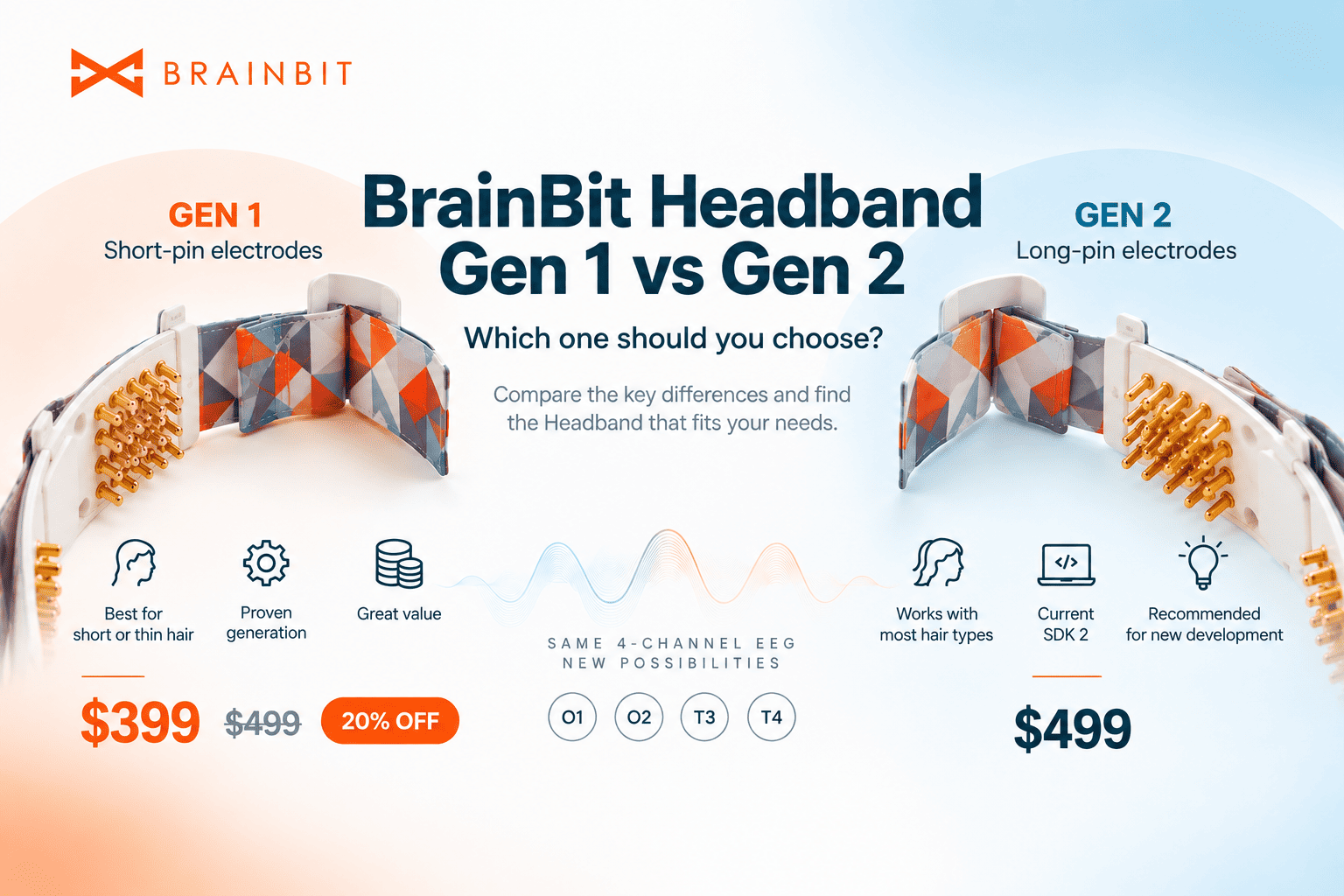
Choosing between two generations of the BrainBit Headband doesn't necessarily mean choosing between "old" and "new."
The better question is: which BrainBit Headband is better suited to the way you plan to use it?
Both generations are wireless 4-channel EEG headbands designed to record brain activity from O1, O2, T3, and T4. They use dry electrodes and Bluetooth connectivity, making EEG acquisition possible without conductive gel and lengthy preparation.
The main differences between BrainBit Headband Gen 1 and Gen 2 are electrode design, user experience, hardware generation, and additional developer-oriented features.
Both generations support neurofeedback, research, and custom EEG application development. The choice largely depends on your hair type, preferred electrode design, and whether your project requires specific Gen 2 capabilities.
And depending on your hair type, workflow, and development plans, Gen 1 may still be exactly what you need.
The Biggest Difference: Short Pins vs Long Pins
The most noticeable difference between the two Headband generations is the electrode design.
BrainBit Headband Gen 1: Short-Pin Electrodes
Gen 1 uses short-pin dry electrodes.
This electrode configuration is particularly well suited for people with short, thin, or sparse hair, providing convenient scalp contact without conductive gel.
The short-pin Headband can also be used with other hair types, although longer or thicker hair may require additional adjustment to establish reliable electrode-to-scalp contact.
BrainBit Headband Gen 2: Long-Pin Electrodes
Gen 2 uses long-pin dry electrodes designed to facilitate scalp contact through different hair types.
This makes Gen 2 particularly versatile for people with longer or thicker hair, as well as professional environments where the same Headband may be used by multiple people.
The longer electrodes offer an alternative fit and contact configuration, while the short-pin version remains particularly convenient for people with shorter or thinner hair.
Neither electrode design is universally better. The right choice depends on the individual user and intended application.
Gen 1 vs Gen 2 for Software Development
Both BrainBit Headband generations can be used for software development, neurofeedback applications, research projects, and brain-computer interfaces.
BrainBit Headband Gen 1 with Short-Pin Electrodes supports both BrainBit SDK 1 and SDK 2.
This makes it a versatile option for developers working with existing integrations as well as those building new EEG applications.
BrainBit Headband Gen 2 with Long-Pin Electrodes supports SDK 2 and features updated electronics, improved Bluetooth connectivity, and additional developer-oriented functionality.
One example is the Ping command, which helps developers estimate communication round-trip time between an application and the Headband.
This can be useful for applications where timing matters, including interactive EEG experiences and experiments involving external stimuli.
The important distinction is that compatibility with SDK 2 does not necessarily mean that both hardware generations support every Gen 2-specific feature.
For many EEG applications, the first-generation Headband provides the functionality developers need. Projects requiring specific Gen 2 capabilities may benefit from the updated hardware platform.
Both generations remain suitable for custom EEG application development.
When Should You Choose BrainBit Headband Gen 1 with Short-Pin Electrodes?
Consider Gen 1 if you:
- Have short, thin, or sparse hair.
- Need wireless 4-channel EEG for neurofeedback, research, or personal use.
- Want to develop custom EEG applications or integrate EEG into an existing project.
- Need compatibility with BrainBit SDK 1 and SDK 2.
- Want a proven BrainBit Headband at a lower current price.
The first-generation BrainBit Headband remains a versatile device for professionals, researchers, developers, and EEG enthusiasts.
Its short-pin electrodes make it particularly convenient for people with shorter or thinner hair, while compatibility with both SDK generations provides flexibility for software development.
If these features meet your needs, you don't necessarily need to choose Gen 2 simply because it is newer.
And right now, there is another reason to consider Gen 1.
Special Offer: BrainBit Headband Gen 1 Is Now $399
BrainBit Headband Gen 1 with short-pin electrodes is currently available for:
$399 instead of $499 - 20% off
The offer is available while supplies last.
For neurofeedback specialists, researchers, developers, and individual EEG enthusiasts, this offer makes the BrainBit Headband with Short Pins an attractive way to access wireless 4-channel EEG with support for both BrainBit SDK 1 and SDK 2.
Shop BrainBit Headband Gen 1 with Short Pin-Electrodes
When Should You Choose BrainBit Headband Gen 2?
Consider Gen 2 if you:
- Have long or thick hair, or need a Headband suitable for a wider range of users.
- Prefer the updated hardware design with a more visible LED indicator.
- Want improved electronics and Bluetooth connectivity.
- Need additional developer-oriented features, such as the Ping command.
- Plan to use software or partner solutions that specifically require Gen 2 hardware.
The second-generation BrainBit Headband introduces several hardware improvements. Its redesigned LED indicator is easier to see without moving the elastic band, making it more convenient to check the device's status. Updated electronics and improved Bluetooth connectivity provide additional benefits for software development and EEG applications. For projects requiring these specific capabilities, Gen 2 offers an updated hardware platform while maintaining the familiar 4-channel BrainBit EEG experience.
BrainBit Headband Gen 1 vs Gen 2 at a Glance
| Gen 1 | Gen 2 | |
| EEG channels |
4 | 4 |
| Electrodes | Short pins | Long pins |
| Best suited for | Short / thin hair | Most hair types |
| Contact through hair | May require adjustment with thick hair | Easier contact through longer hair |
| LED indicator | Less visible |
More visible |
| Hardware |
First generation | Updated electronics |
| Bluetooth |
Standard connectivity | Improved connectivity |
| SDK | SDK 1 & SDK 2 | SDK 2 |
| Software development | Supported | Supported |
| Additional developer features |
Core EEG functionality | Gen 2-specific features, including Ping |
| Current price | $399 sale | $499 |
The takeaway is simple:
You don't always need the newest generation. You need the right one.
Prefer a Visual Comparison?
Want to see the two BrainBit Headbands side by side?
Our interactive guide compares electrode design, hair type suitability, hardware features, SDK compatibility, software options, and pricing to help you choose the right Headband for your needs.
Software for Your BrainBit Headband
The BrainBit Headband is part of a broader software ecosystem, so you don't necessarily need to build your own application to start working with EEG.
Depending on your workflow, BrainBit software includes:
NeuroFit PRO - professional neurofeedback software designed for practitioners, psychotherapists, and specialists.
NeuroRec - EEG recording, visualization, and analysis software for professionals, researchers, and users who want to observe and work with EEG signals.
EEG Waves - an application for viewing EEG rhythms and exploring brain activity in real time.
BrainBit Neurofeedback App - mobile neurofeedback training for professional and personal use.
Before choosing a Headband for a specific third-party or partner solution, we recommend checking its generation compatibility.
Need More EEG Channels? Meet BrainBit Headband Pro
Gen 1 and Gen 2 aren't the only options in the BrainBit hardware ecosystem.
If your application requires more EEG channels and broader scalp coverage, consider BrainBit Headband Pro.
Headband Pro provides 8 EEG channels with flexible 10–20 electrode positioning and is designed for more advanced applications, including research, BCI prototyping, neurofeedback, and education.
For most people choosing between the standard BrainBit Headbands, however, the decision remains straightforward:
Gen 1 → Short-pin electrodes, compatibility with SDK 1 and SDK 2, versatile 4-channel EEG, and the best current price.
Gen 2 → Long-pin electrodes, updated electronics, improved Bluetooth connectivity, and additional developer-oriented features.
Headband Pro → 8-channel applications requiring broader EEG coverage.
Which BrainBit Headband Is Right for You?
Both generations offer wireless 4-channel EEG for neurofeedback, research, and software development.
If you have short or thin hair and want a versatile Headband with support for both SDK 1 and SDK 2, the first-generation BrainBit Headband with Short Pins is an excellent option, especially at its current promotional price of $399.
If you need longer electrodes for different hair types, updated electronics, improved Bluetooth connectivity, or additional developer-oriented features, consider the second-generation BrainBit Headband.
And if your work requires more EEG channels and broader scalp coverage, BrainBit Headband Pro may be the right solution.
Still not sure?
Tell us how you plan to use your BrainBit Headband, and our team will help you choose the right version.
Get in touch: info@brainbit.com