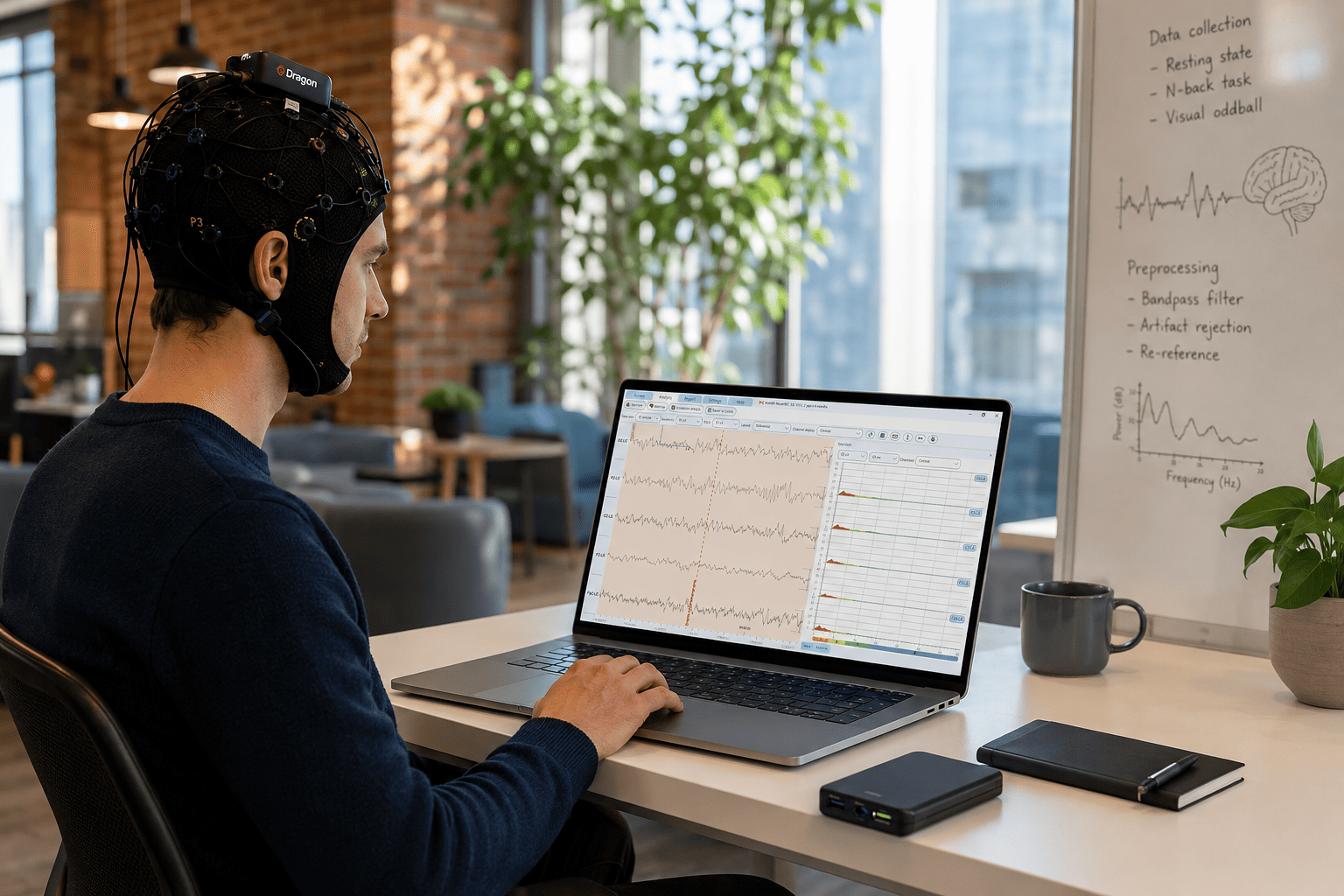
Portable EEG technology has transformed the way researchers collect and analyze brain activity. Instead of relying solely on fixed laboratory environments, modern wireless EEG systems enable data acquisition in universities, research institutes, innovation labs, and real-world settings while maintaining high signal quality.
At the same time, advances in quantitative EEG (qEEG) software have made it possible to move beyond simple signal recording toward deeper analysis of brainwave activity. Today, researchers can acquire EEG data, review signal quality, process recordings, visualize brainwave patterns, and generate quantitative reports using an integrated workflow.
Understanding how these technologies work together is essential when selecting an EEG system for neuroscience, cognitive science, human factors, or neurotechnology research.
This guide explains how portable EEG systems support qEEG workflows and what to consider when building an efficient research environment.
What Is a Portable EEG System?
A portable EEG system is designed to record electrical activity generated by the brain while providing greater flexibility than traditional desktop-based equipment.
Modern portable systems typically include:
- lightweight EEG amplifier
- wireless communication
- rechargeable battery
- EEG acquisition software
- synchronized data recording
- export capabilities for analysis
Compared with earlier generations of EEG equipment, portable systems allow researchers to conduct studies in a much wider variety of environments while simplifying participant preparation and equipment transport.
This flexibility has made portable EEG increasingly popular for cognitive research, education, usability studies, sports science, and human performance research.
From EEG Recording to qEEG Analysis
Recording EEG data is only the first step in the research process.
A complete workflow typically includes:
- Preparing the participant
- Recording EEG activity
- Reviewing signal quality
- Identifying recording artifacts
- Processing the data
- Performing quantitative analysis
- Visualizing results
- Exporting findings for further research
Many first-time users focus primarily on hardware specifications, but experienced researchers understand that software and workflow efficiency are equally important.
The goal is not simply to collect EEG data, it is to generate reliable information that can support meaningful scientific analysis.
Understanding the Difference Between EEG and qEEG
Although the terms are often used interchangeably, EEG and qEEG describe different stages of the research process.
EEG (Electroencephalography) refers to the acquisition of electrical activity from the scalp. The recording captures raw brainwave signals over time, providing researchers with the data needed for further analysis.
Quantitative EEG (qEEG) builds on this foundation by applying computational methods to EEG recordings. Instead of viewing only raw waveforms, researchers can examine frequency distributions, compare brainwave activity across regions, generate topographic maps, and identify statistical patterns within the recorded data.
In simple terms:
- EEG records brain activity.
- qEEG analyzes and visualizes that activity.
Understanding this distinction helps researchers evaluate complete solutions rather than focusing solely on recording hardware.
Why Portability Matters in Modern Research
Scientific research increasingly extends beyond traditional laboratory environments.
Portable EEG systems make it possible to investigate brain activity during more natural tasks and in more diverse settings.
Examples include:
- classroom learning
- virtual reality studies
- usability testing
- human-computer interaction
- sports performance research
- workplace cognition
- field experiments
Wireless operation also improves participant comfort by reducing cable management and simplifying study setup.
As research questions become more dynamic, portability becomes an important advantage rather than simply a convenience.
Signal Quality Remains the Foundation
Regardless of where data are collected, signal quality determines the value of every recording.
Researchers should evaluate:
- amplifier performance
- electrode stability
- motion resistance
- synchronization
- sampling rate
- recording consistency
Even the most sophisticated analysis software cannot compensate for poor-quality recordings.
Proper signal acquisition remains the foundation of every successful qEEG workflow.
Read more about EEG artifacts.
Building an Efficient qEEG Workflow
One of the biggest challenges for research teams is integrating hardware and software from multiple vendors.
A typical workflow often requires:
- EEG acquisition
- data review
- artifact inspection
- frequency analysis
- visualization
- reporting
- data export
When these components are designed to work together, researchers spend less time configuring systems and more time conducting studies.
Integrated solutions also reduce compatibility concerns and simplify training for new users.
Benefits of an Integrated EEG and qEEG Bundle
Many research groups prefer complete solutions that combine recording hardware with compatible analysis software.
An integrated bundle offers several advantages:
- simplified installation
- optimized compatibility
- streamlined workflows
- reduced setup time
- easier onboarding for research teams
- consistent software updates
- centralized support
Rather than assembling separate components, researchers can begin collecting and analyzing EEG data more efficiently.
Who Can Benefit from Portable qEEG Systems?
Portable EEG and qEEG workflows support a wide range of research environments.
Examples include:
- universities
- neuroscience laboratories
- human factors research
- cognitive science
- sports science
- educational technology
- UX and usability research
- brain-computer interface development
- neurotechnology innovation
Because portable systems are easier to transport and deploy, they also enable collaboration across multiple research locations.
What to Consider Before Choosing a System
Before investing in a portable EEG solution, researchers should evaluate more than hardware specifications.
Key considerations include:
- channel count
- wireless reliability
- signal quality
- software compatibility
- qEEG workflow
- export options
- ease of participant setup
- long-term scalability
- technical support
- future research needs
Selecting a system that integrates acquisition and analysis can improve efficiency throughout the life of a research project.
Frequently Asked Questions
What is the difference between EEG and qEEG?
EEG records electrical activity from the brain, while qEEG applies quantitative analysis methods to EEG recordings to visualize and compare brainwave patterns.
Can portable EEG systems be used for qEEG?
Yes. Modern portable EEG systems can provide high-quality recordings suitable for quantitative analysis when paired with compatible software.
Why is portability important?
Portable systems allow researchers to collect EEG data in a wider variety of environments while simplifying setup and transportation.
Does qEEG require special software?
Yes. qEEG analysis relies on software capable of processing EEG recordings, calculating quantitative metrics, and presenting visualizations.
Why choose an integrated solution?
Integrated hardware and software reduce compatibility issues, simplify installation, and create a more efficient workflow.
How many EEG channels are recommended for research?
The optimal number depends on the research objective, but 21-channel systems offer a practical balance between comprehensive brain coverage, usability, and portability for many studies.
Conclusion
Portable EEG technology has reshaped modern neuroscience and neurotechnology research by making high-quality brainwave recording more flexible and accessible. When combined with qEEG analysis software, researchers gain a complete workflow that extends beyond data acquisition to include signal review, quantitative analysis, visualization, and reporting.
Rather than evaluating hardware or software in isolation, it is beneficial to consider how each component contributes to an efficient research process. Integrated solutions that combine portable EEG recording with compatible qEEG analysis tools help research teams reduce setup complexity, maintain consistent workflows, and focus on generating meaningful scientific insights.
For organizations seeking a complete research platform, combining a 21-channel wireless EEG system with an integrated 21-channel EEG + qEEG software bundle provides a streamlined approach to EEG acquisition and quantitative analysis, supporting a broad range of neuroscience and neurotechnology projects.