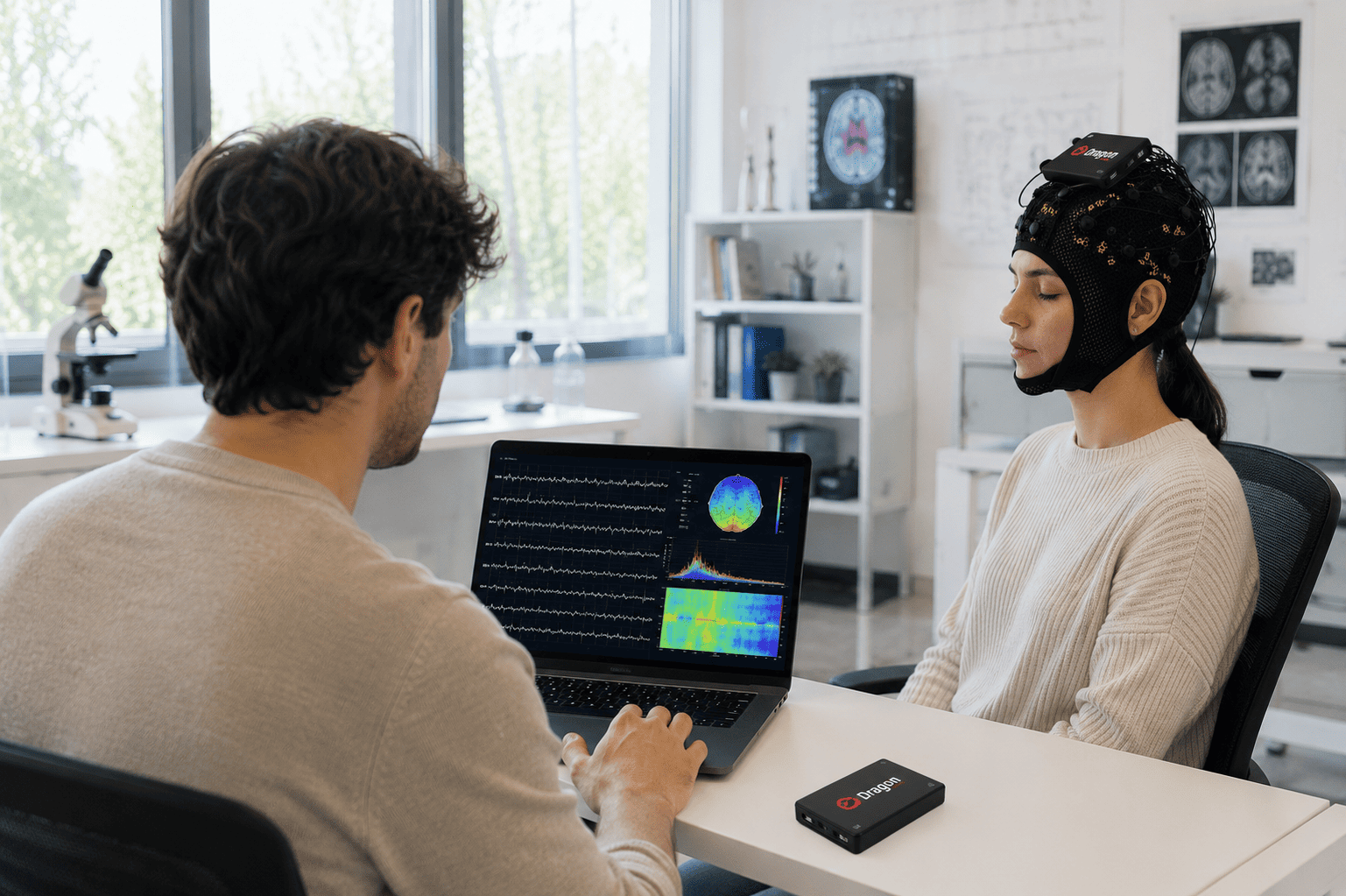
Choosing a research EEG system is one of the most important decisions for any neuroscience laboratory, university, technology company, or research organization. The right hardware can influence data quality, study flexibility, participant comfort, and long-term research capabilities.
Today's EEG systems are more portable, more reliable, and more versatile than ever before. Wireless technology, lightweight amplifiers, improved electrode designs, and real-time software have expanded EEG beyond traditional laboratory environments. Researchers can now conduct experiments in classrooms, offices, sports facilities, field environments, and mobile laboratories while maintaining high-quality data acquisition.
However, with so many systems available, selecting the right solution isn't always straightforward. Channel count, electrode type, sampling rate, software compatibility, synchronization, battery life, and portability all play important roles depending on your research goals.
This guide explains the key factors to consider before investing in an EEG system and provides practical advice for selecting hardware that meets both current and future research needs.
What Is a Research EEG System?
A research EEG system is designed to measure the brain's electrical activity with high precision for scientific investigation, product development, and experimental applications. Unlike consumer brainwave devices, research-grade systems prioritize signal quality, data accessibility, synchronization options, and flexibility for advanced studies.
A typical research EEG system includes:
- EEG amplifier
- electrodes
- acquisition software
- data recording tools
- synchronization interfaces
- export capabilities
- analysis software compatibility
Modern systems increasingly include wireless communication, allowing participants to move more naturally while maintaining stable signal acquisition.
Portable wireless systems have significantly expanded research possibilities, making it easier to conduct experiments outside traditional laboratory settings.
Define Your Research Goals First
Before comparing technical specifications, define the primary purpose of your EEG system.
Ask yourself:
- Will participants remain seated or move during experiments?
- Will the system be used in a laboratory or real-world environments?
- How many participants will be tested?
- Will experiments require event markers or external device synchronization?
- Will you need real-time data access?
- Are you planning future software development?
The answers influence nearly every hardware decision.
For example, researchers conducting classroom attention studies may prioritize portability, while cognitive neuroscience laboratories might emphasize synchronization with experimental software.
Portable vs. Traditional EEG Systems
One of the biggest decisions involves choosing between portable and traditional laboratory systems.

Portable wireless EEG systems have become increasingly popular because they enable research beyond controlled laboratory settings.
Researchers now perform EEG studies in:
- universities
- classrooms
- offices
- athletic facilities
- usability laboratories
- virtual reality environments
- human-computer interaction studies
How Many EEG Channels Do You Need?
The number of recording channels directly influences spatial resolution and research flexibility.
8–16 Channels
Suitable for:
- educational demonstrations
- simple cognitive experiments
- prototype development
21 Channels
A balanced choice for many research projects.
Benefits include:
- comprehensive brain coverage
- manageable setup time
- efficient data collection
- excellent balance between complexity and usability
- Twenty-one channels are widely used in cognitive neuroscience, human performance research, and brain-computer interface development.
32–64 Channels
Appropriate when higher spatial resolution is required for specialized experimental protocols.
Higher channel counts also increase setup time, preparation, and data processing requirements.
A 21-channel wireless EEG system often provides an excellent balance between research flexibility and operational efficiency.
Understanding EEG Electrodes
Electrode technology significantly affects user experience and recording quality.
Dry Electrodes
Advantages:
- rapid setup
- no conductive gel
- easier participant preparation
- improved portability
Wet Electrodes
Advantages:
- traditional research standard
- stable contact for longer recordings
Limitations:
- longer preparation
- cleanup required
- greater maintenance
The best choice depends on research workflow rather than assuming one approach is universally superior.
Sampling Rate Explained
Sampling rate determines how frequently the EEG signal is recorded each second.
Common values include:
- 250 Hz
- 500 Hz
- 1000 Hz
- 2000+ Hz
Higher sampling rates generate more detailed data but also increase storage requirements and processing demands.
Selecting the appropriate sampling rate should align with the objectives of your research rather than simply choosing the highest available specification.
Why Signal Quality Matters More Than Specifications
Many buyers focus on specifications while overlooking signal quality.
Reliable EEG acquisition depends on:
- electrode contact
- amplifier design
- shielding
- motion resistance
- synchronization accuracy
- environmental noise reduction
High-quality EEG signals reduce preprocessing time and improve confidence in downstream analyses.
Researchers should evaluate the complete acquisition workflow rather than comparing specifications alone.
Software Can Be Just as Important as Hardware
A research EEG system should integrate smoothly with your workflow.
Consider:
- real-time visualization
- event markers
- data export formats
- SDK availability
- API documentation
- synchronization capabilities
- scripting support
Open development tools provide greater flexibility for laboratories building custom applications.
If your team develops software, SDK availability can be as important as amplifier specifications.
Connectivity and Integration
Modern neuroscience research increasingly involves multiple synchronized devices.
Examples include:
- eye tracking
- motion capture
- virtual reality
- physiological sensors
- behavioral testing software
- custom applications
Selecting a system capable of integrating with these technologies improves future scalability.
Choosing an EEG System for Different Research Areas


Why Researchers Choose Portable Wireless EEG
Portable EEG systems continue gaining popularity because they reduce logistical barriers while expanding experimental possibilities.
Benefits include:
- faster participant preparation
- flexible study locations
- improved comfort
- simplified transportation
- easier deployment
- support for naturalistic experiments
For many modern research projects, portability is becoming a practical advantage rather than an optional feature.
Questions to Ask Before Purchasing
Before investing in an EEG system, consider the following checklist:
- Does it support your required number of channels?
- Can data be exported in standard formats?
- Is software included?
- Does it offer real-time streaming?
- Is an SDK available?
- How portable is the hardware?
- How long does the battery last?
- Does it support future expansion?
- How easy is participant setup?
- What level of technical support is available?
Answering these questions helps ensure that your chosen system remains useful as research needs evolve.
Frequently Asked Questions
What is a research EEG system?
A research EEG system is designed for scientific studies and advanced EEG data acquisition, providing reliable recordings, flexible software integration, and high-quality signal capture.
Is a portable EEG system accurate?
Modern portable EEG systems can deliver high-quality recordings suitable for many research applications when properly designed and used according to best practices.
How many EEG channels are enough?
The ideal channel count depends on the research objective. Twenty-one channels often provide an excellent balance between spatial coverage and operational efficiency.
Are wireless EEG systems reliable?
Wireless technology has advanced significantly and is widely used for mobile and laboratory research, particularly when participant movement or flexible study locations are important.
Why is EEG software important?
Software determines how data are recorded, visualized, synchronized, exported, and integrated into research workflows.
Can researchers build custom EEG applications?
Yes. Systems with SDKs and APIs allow researchers and developers to create custom acquisition, visualization, and analysis tools.
What factors affect EEG signal quality?
Signal quality depends on electrode contact, amplifier design, environmental conditions, participant movement, and recording protocols.
What should I compare before buying an EEG system?
Researchers should evaluate channel count, portability, software, sampling rate, signal quality, battery life, SDK availability, and long-term scalability.
Conclusion
Selecting the right research EEG system involves much more than comparing technical specifications. Researchers should consider how the hardware fits their experimental workflow, software ecosystem, participant experience, and future development plans.
Portable wireless EEG technology has opened new opportunities for neuroscience, cognitive research, human performance studies, education, and brain-computer interface development. By evaluating channel count, electrode design, signal quality, software compatibility, and integration capabilities together, research teams can choose a system that supports both current projects and future innovation.
If you're exploring a modern 21-channel wireless EEG system for research applications, DragonEEG combines portability, research-grade performance, and flexible software integration for a wide range of neuroscience and neurotechnology projects.