Introduction to Neurotech Coaching Applications
The coaching industry is rapidly evolving. Today’s coaches are no longer relying only on observation, subjective feedback, and traditional performance tracking methods. Neurotechnology is introducing a new layer of insight by allowing coaches to monitor cognitive states, attention levels, stress responses, and mental performance in real time.
Designing neurotech apps for coaches has become one of the most promising areas in wearable EEG development. These applications combine neuroscience, software engineering, and real-time analytics to create tools that support cognitive performance, neurofeedback, recovery training, and mental optimization.
As wearable EEG technology becomes more accessible, developers and businesses have an opportunity to build applications that help coaches better understand how the brain responds during training, learning, and performance situations.
Why Neurotechnology Is Growing in Coaching
The Rise of Data-Driven Performance Training
Modern coaching increasingly depends on measurable insights. Athletes, executives, students, and wellness clients want more than motivation, they want actionable data.
Neurotechnology provides:
- real-time cognitive feedback
- stress and recovery indicators
- focus and attention measurements
- brainwave activity analysis
This allows coaches to personalize programs and monitor mental performance more effectively.
Explore how neurotechnology supports performance applications on the application development and performance coaching page
The Shift Toward Cognitive Performance Optimization
Physical training has long been supported by metrics like heart rate, sleep tracking, and movement analysis. Neurotechnology adds the missing cognitive layer.
Today, coaches are exploring:
- attention training
- mental resilience
- emotional regulation
- neurofeedback-assisted performance
This creates demand for applications that can transform EEG data into meaningful coaching insights.
What Are Neurotech Apps?
Understanding EEG-Based Applications
Neurotech apps are software platforms that use physiological brain data to deliver feedback, analytics, or training experiences.
Many of these applications rely on EEG (electroencephalography), which measures electrical activity generated by the brain.
Common neurotech app functions include:
- real-time brainwave monitoring
- neurofeedback training
- cognitive performance tracking
- relaxation and meditation analysis
- focus measurement
These applications can be used on desktop systems, tablets, smartphones, and cloud-based platforms.
Real-Time Brain Monitoring
One of the most powerful features of modern neurotech applications is real-time brain monitoring.
With wearable EEG devices, applications can detect changes in:
- alpha activity
- beta activity
- theta rhythms
- cognitive load
- relaxation levels
Real-time feedback helps coaches adapt exercises and training sessions instantly.
Neurofeedback and Cognitive Performance
Neurofeedback applications use EEG signals to help users learn how to regulate brain activity.
For coaches, this creates opportunities to support:
- concentration training
- stress reduction
- performance readiness
- mental recovery
The growing interest in neurofeedback has expanded the need for intuitive, scalable software solutions.
Why Coaches Are Using Neurotechnology
Performance Coaching
Performance coaches are increasingly integrating neurotechnology into their workflows.
EEG-powered applications help measure:
- mental fatigue
- cognitive engagement
- focus consistency
- training readiness
This provides a deeper understanding of performance beyond physical metrics.
Mental Fitness and Cognitive Training
Mental performance is now recognized as a major component of success in sports, education, and business.
Neurotech applications help coaches create exercises focused on:
- attention control
- reaction speed
- mental endurance
- cognitive flexibility
Stress and Recovery Monitoring
Stress directly affects performance. Neurotechnology applications can help coaches monitor recovery states using brainwave patterns associated with relaxation and cognitive overload.
Applications may include:
- guided recovery sessions
- relaxation feedback systems
- meditation tracking
Focus and Attention Optimization
Attention training is one of the most common use cases in neurofeedback and EEG coaching.
Applications often monitor:
- sustained attention
- distraction levels
- cognitive engagement
This can benefit athletes, students, professionals, and gamers.
Core Features of Neurotech Apps for Coaches
Real-Time EEG Data Visualization
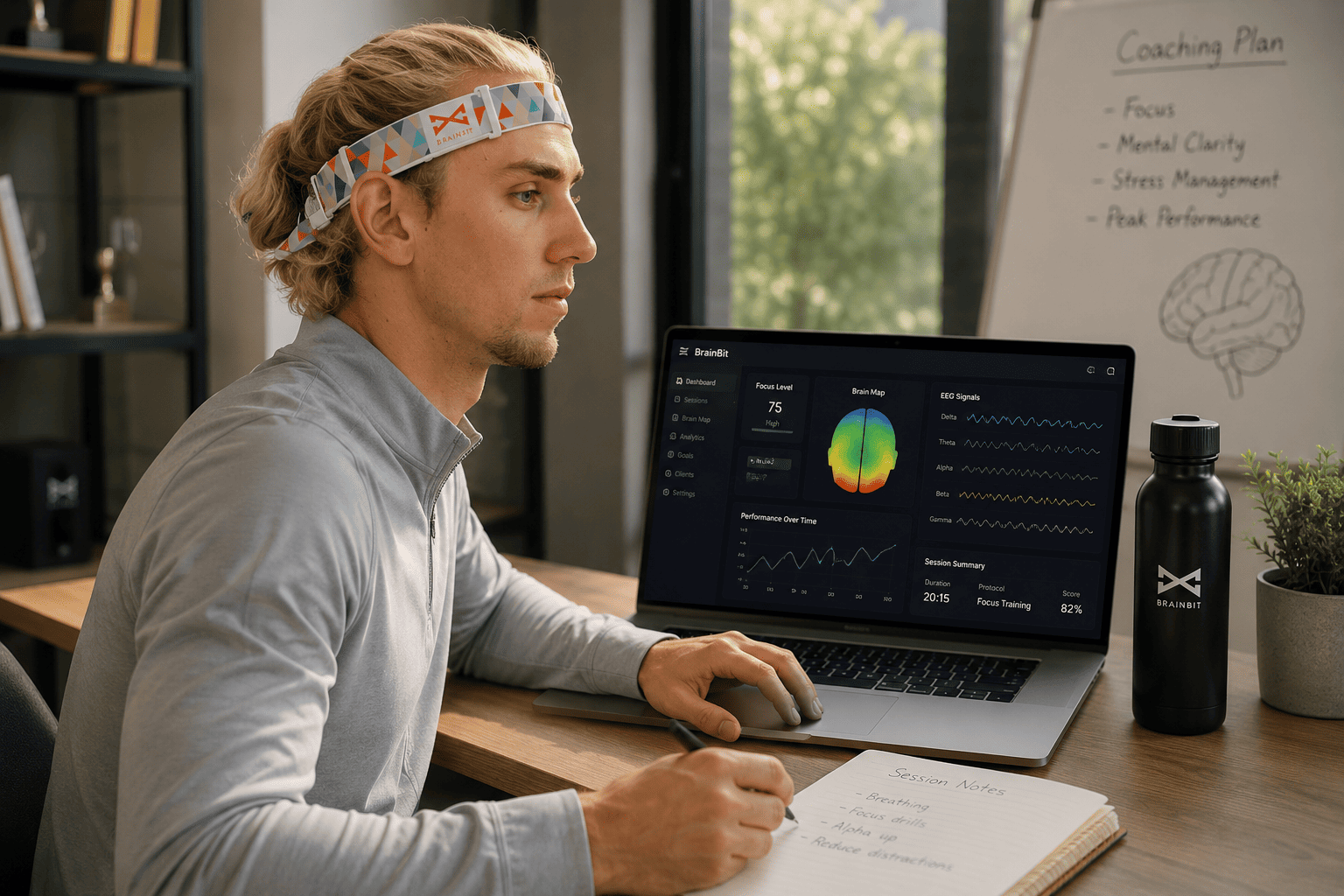
Visualization is critical. Coaches need clear, understandable insights rather than raw EEG signals.
Good neurotech apps use:
- live graphs
- focus indicators
- cognitive state dashboards
- session summaries
Brainwave Analytics
Many applications analyze:
- alpha/beta ratios
- theta activity
- cognitive state transitions
These metrics can help identify patterns in focus, stress, and recovery.
Session Tracking and Progress Reports
Long-term tracking allows coaches to monitor improvement over time.
Important features include:
- session history
- cognitive trends
- performance scoring
- exportable reports
Personalized Neurofeedback Protocols
Modern neurotech platforms increasingly focus on adaptive training.
Applications may adjust:
- difficulty levels
- training intensity
- feedback methods
based on user performance and EEG patterns.
Mobile and Cloud Integration
Cloud-enabled neurotech apps allow:
- remote coaching
- data synchronization
- multi-device access
This is especially important for distributed coaching environments.
Designing User-Friendly Neurotech Applications
Simplicity vs Technical Complexity
One of the biggest mistakes in neurotech app design is overwhelming users with excessive technical data.
Coaches typically need:
- actionable insights
- intuitive dashboards
- simple metrics
rather than complex neuroscience terminology.
UX Design for Coaches and Clients
Good user experience is essential.
Neurotech applications should be:
- easy to navigate
- visually clean
- responsive in real time
This improves adoption and usability.
Building Clear Dashboards
Dashboards should focus on:
- focus levels
- stress indicators
- training scores
- recovery trends
Visual simplicity increases usability.
Making Brain Data Understandable
The best neurotech apps translate EEG signals into practical coaching information.
For example:
- “focus increasing”
- “stress elevated”
- “recovery improving”
instead of raw signal data.
Read How to Build an EEG Application Using BrainBit SDK
How EEG Devices Power Coaching Apps
Wearable EEG Technology
Wearable EEG systems make neurotechnology accessible outside laboratories.
Modern devices are:
- lightweight
- wireless
- portable
- suitable for real-world environments
Explore wearable EEG applications.
Wireless Brain Monitoring
Wireless EEG devices enable:
- mobility during training
- real-time coaching environments
- remote monitoring
This is especially useful in sports and wellness applications.
Multi-Channel EEG Systems
Multi-channel EEG devices provide richer brain data and more advanced analytics.
This enables:
- more precise neurofeedback
- better signal interpretation
- advanced cognitive analysis
Real-Time Signal Processing
Real-time processing is essential for interactive neurofeedback experiences.
Applications must handle:
- filtering
- artifact removal
- brainwave analysis
- low-latency visualization
Neurofeedback Applications in Coaching
Attention and Focus Training
Focus training applications help users maintain concentration under pressure.
These systems are widely used in:
- sports performance
- esports
- executive coaching
- education
Relaxation and Recovery Programs
Recovery-focused applications use EEG data to guide users into relaxed states.
These programs may include:
- breathing exercises
- meditation training
- guided neurofeedback
Cognitive Performance Optimization
Coaches increasingly use neurotechnology to optimize:
- reaction time
- mental endurance
- cognitive flexibility
- stress resilience
Peak Performance Training
Peak performance coaching often combines:
- EEG
- biometrics
- cognitive training
- performance analytics
to support elite-level performance.
Developing Neurotech Apps with BrainBit SDK
Why Developers Choose BrainBit
BrainBit provides wearable EEG solutions and SDK tools designed for developers building neurotechnology applications.
The ecosystem supports:
- real-time EEG streaming
- software integration
- wearable EEG development
- custom neurofeedback applications
EEG SDK Integration
Developers can integrate EEG functionality into applications using BrainBit SDK.
This enables:
- real-time signal acquisition
- cognitive analytics
- neurofeedback systems
- interactive experiences
Cross-Platform Development
Modern neurotech apps often require support across:
- desktop platforms
- mobile apps
- Unity environments
- cloud systems
Cross-platform compatibility improves scalability.
Building Scalable Neurotech Solutions
Scalable architecture is important for commercial neurotechnology products.
Developers should focus on:
- efficient data pipelines
- low-latency processing
- cloud integration
- secure storage
Industries Using Neurotech Coaching Apps
Sports Performance
Athletes use neurotechnology to train focus, reaction time, and mental resilience.
Executive Coaching
Executives increasingly use cognitive performance tools for productivity and stress management.
Education and Learning
Educational applications help students improve concentration and cognitive engagement.
Wellness and Meditation
Meditation and mindfulness applications increasingly integrate EEG feedback.
Challenges in Neurotech App Development
Signal Noise and Artifacts
EEG signals are highly sensitive to:
- movement
- muscle activity
- environmental interference
Applications need strong filtering systems.
Data Interpretation
Brain activity is complex and varies between users.
Applications should avoid oversimplification while remaining understandable.
User Adoption
Neurotechnology applications must feel approachable and useful to non-technical users.
Privacy and Brain Data Security
Brain data is sensitive.
Developers should prioritize:
- encryption
- secure storage
- transparent privacy practices
Future Trends in Neurotechnology Coaching
AI-Powered Neurofeedback
Artificial intelligence is making neurofeedback systems more adaptive and personalized.
Adaptive Cognitive Training
Future apps may automatically adjust exercises based on real-time cognitive states.
Wearable Neurotechnology Ecosystems
EEG devices are increasingly integrating with:
- wearables
- mobile platforms
- cloud systems
- wellness technologies
Brain-Computer Interfaces
BCI technology may eventually become part of mainstream coaching applications.
FAQs
What is a neurotech coaching app?
A neurotech coaching app uses physiological data, often EEG signals, to support cognitive performance training and neurofeedback.
Can EEG improve coaching programs?
EEG can provide additional insight into focus, stress, recovery, and cognitive engagement.
What industries use neurofeedback apps?
Sports, wellness, education, executive coaching, and cognitive training industries use neurofeedback technology.
Do coaches need neuroscience expertise?
Not necessarily. Modern applications simplify brain data into understandable metrics.
Can developers build custom neurofeedback apps?
Yes. SDK platforms like BrainBit SDK support custom EEG application development.
Are wearable EEG devices practical outside laboratories?
Yes. Modern wearable EEG devices are designed for mobile, real-world use.
Conclusion
Designing neurotech apps for coaches represents one of the most exciting opportunities in modern neurotechnology. As EEG devices become more accessible and software ecosystems continue to evolve, coaches can now integrate cognitive insights into training, wellness, education, and performance programs.
For developers and businesses, this creates a rapidly growing field where wearable EEG, neurofeedback, real-time analytics, and adaptive cognitive training come together to support practical, scalable applications.
By combining intuitive design, meaningful brain data interpretation, and reliable EEG technology, neurotech applications can help shape the future of performance coaching and cognitive optimization.