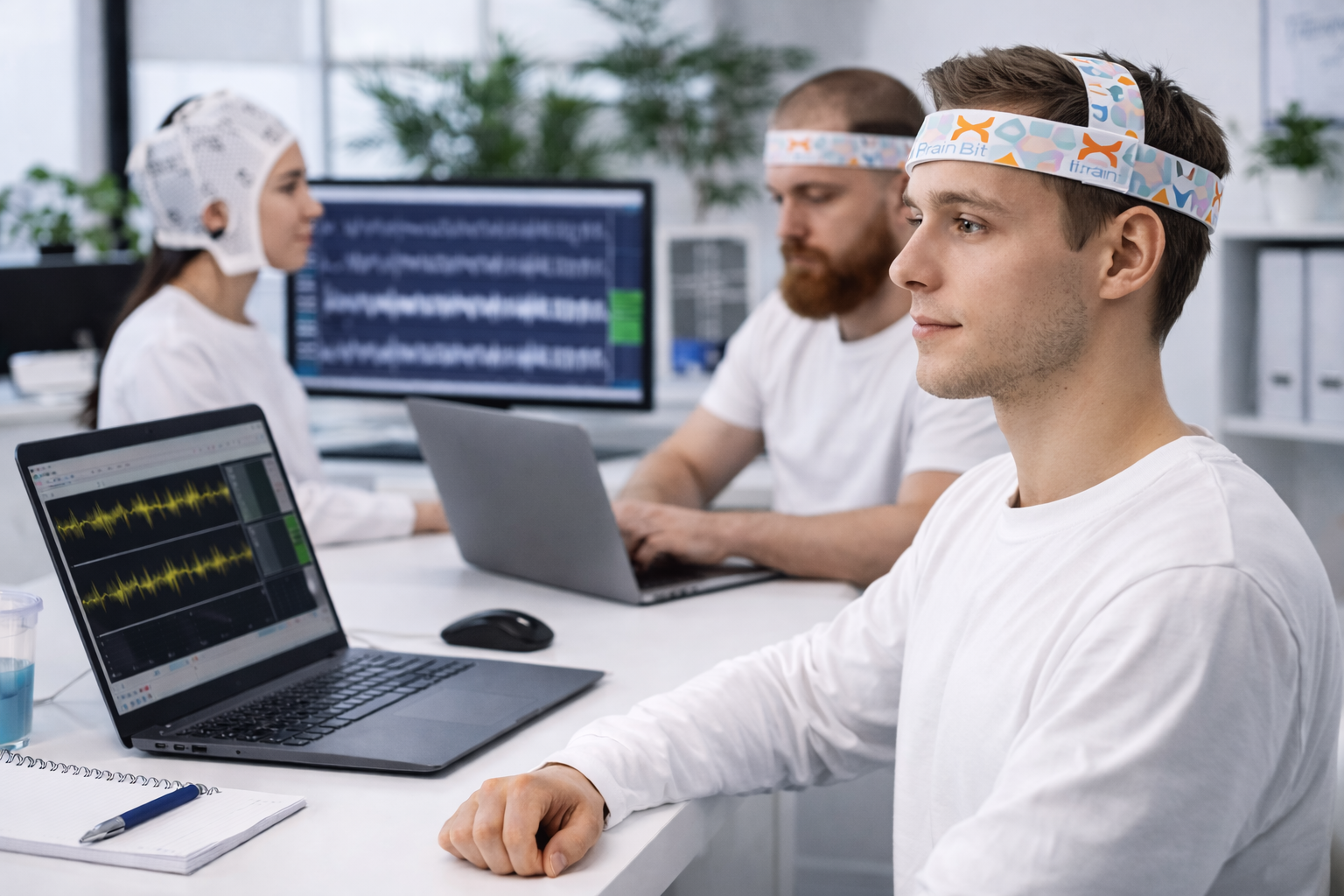
Wearable EEG is transforming how researchers, developers, and neuroscientists collect and analyze brain data. But what is wearable EEG exactly, and how does it differ from traditional electroencephalography systems?
In this complete guide, we will explore wearable EEG from a technical and practical perspective. Whether you are building a brain-computer interface (BCI), running cognitive neuroscience experiments, or developing neurofeedback software, understanding wearable EEG systems is essential.
This article covers:
- Electroencephalography fundamentals
- EEG signal acquisition
- Dry vs wet electrodes
- Sampling rate and signal quality
- EEG channel configurations
- Wearable vs laboratory EEG
- Developer integration and SDK considerations
- Research applications
- Limitations and best practices
- Let’s begin with the foundation.
Understanding Electroencephalography (EEG)
Electroencephalography (EEG) is a non-invasive method of measuring electrical activity in the brain. Neurons communicate through electrical impulses. When groups of neurons fire synchronously, they generate measurable voltage fluctuations that can be detected on the scalp.
These signals are known as brainwaves or neural oscillations.
Major Brainwave Frequency Bands

EEG devices measure these oscillations using electrodes placed on the scalp, often following the International 10–20 system, which standardizes electrode placement (Fp1, Fp2, C3, C4, O1, O2, etc.).
Traditional EEG systems are typically laboratory-based, use gel-based electrodes, and require trained technicians. Wearable EEG changes this model.
What Is Wearable EEG?
Wearable EEG refers to portable, lightweight, often wireless electroencephalography systems designed for use outside traditional clinical laboratory environments.
Unlike clinical EEG systems that may use 16–64+ channels with wet electrodes, wearable EEG devices typically offer:
- 4–16 channels
- Dry or semi-dry electrodes
- Bluetooth Low Energy (BLE) connectivity
- Battery-powered operation
- Real-time EEG streaming
Wearable EEG systems enable brain signal acquisition in naturalistic settings, including offices, classrooms, homes, and research environments.
Core Components of a Wearable EEG System
To understand wearable EEG, researchers and developers must understand its hardware architecture.
1. EEG Electrodes
Electrodes detect voltage differences on the scalp. There are two main types:
Wet Electrodes
- Require conductive gel
- Lower impedance
- High signal quality
- Longer setup time
Dry Electrodes
- No gel required
- Faster setup
- Higher impedance
- More convenient for wearable systems
Many modern wearable EEG devices use gold-plated dry electrodes with pogo pins to maintain contact through hair.
2. EEG Amplifier
Brain signals are extremely small (microvolt range). An EEG amplifier:
- Boosts signal amplitude
- Reduces noise
- Improves signal-to-noise ratio (SNR)
- Filters unwanted frequencies
High-quality amplifiers are essential for reliable data acquisition.
3. Analog-to-Digital Converter (ADC)
The ADC converts analog brain signals into digital data.
Important specifications include:
- Bit resolution (e.g., 24-bit preferred for research)
- Sampling rate (e.g., 250 Hz, 500 Hz, 1000 Hz)
4. Wireless Transmission (BLE EEG)
Most wearable EEG systems use Bluetooth Low Energy for real-time EEG streaming.
Developers must consider:
- Latency
- Packet loss
- Data buffering
- SDK compatibility
Sampling Rate in Wearable EEG
Sampling rate determines how often brain signals are measured per second.
Common wearable EEG sampling rates:
- 250 Hz – Suitable for neurofeedback and most cognitive tasks
- 500 Hz – Better time resolution
- 1000 Hz+ – Required for detailed ERP studies
For most wearable applications, 250 Hz provides adequate coverage for alpha, beta, theta, and delta frequency bands.
Higher sampling rates increase:
- Data size
- Power consumption
- Processing demands
Developers must balance performance with efficiency.
EEG Channel Count: How Many Channels Are Enough?
Channel count determines spatial resolution.

Eight-channel wearable EEG systems provide a strong balance between portability and spatial coverage. They allow monitoring across frontal, central, temporal, and occipital regions.
For example:
- Fp1, Fp2 – Frontal cortex
- C3, C4 – Motor cortex
- O1, O2 – Occipital lobe
This enables motor imagery experiments, attention tracking, and visual processing research.
Signal Quality in Wearable EEG
One of the biggest questions researchers ask:
Is wearable EEG reliable?
Signal quality depends on:
- Electrode contact impedance
- Motion artifacts
- Muscle activity (EMG interference)
- Eye movement artifacts (EOG)
- Environmental noise
Common EEG Artifacts
- Eye blinks
- Jaw clenching
- Head movement
- Power line interference
Developers often apply:
- Band-pass filtering
- Notch filtering (50/60 Hz)
- Independent Component Analysis (ICA)
- Artifact rejection algorithms
Proper signal preprocessing is essential.
Wearable EEG vs Laboratory EEG

Wearable EEG does not replace clinical EEG but complements it by enabling ecological validity in experiments.
Applications of Wearable EEG
Wearable EEG is used across multiple domains.
1. Neurofeedback
Real-time EEG feedback allows users to train brainwave patterns. Applications include:
- Attention regulation
- Stress monitoring
- Cognitive training
2. Brain-Computer Interface (BCI)
BCI systems translate EEG signals into commands.
Common paradigms include:
- Motor imagery (C3/C4 activation)
- Steady-State Visual Evoked Potentials (SSVEP)
- P300 ERP detection
Wearable EEG enables portable BCI prototyping.
3. Cognitive Neuroscience Research
Researchers study:
- Attention networks
- Memory encoding
- Decision-making
- Mental fatigue
Wearable systems allow data collection outside rigid lab settings.
4. Human-Computer Interaction (HCI)
EEG is increasingly integrated into:
- Adaptive interfaces
- Neuroadaptive gaming
- Emotion-aware systems
Developers use machine learning classification to decode EEG features in real time.
Wearable EEG for Developers: Integration Considerations
If you are building software around EEG hardware, you must consider:
SDK & API Access
- Real-time streaming
- Data packet structure
- Multi-platform support (Windows, iOS, Android, Python, Unity)
Data Processing Pipeline
- Signal acquisition
- Filtering
- Feature extraction (PSD, band power)
- Machine learning classification
- Output command
Latency Optimization
BCI applications require low latency to ensure smooth control.
EEG Feature Extraction for BCI
Common features include:
- Power Spectral Density (PSD)
- Band power ratios
- Event-related potentials (ERP)
- Time-frequency analysis
- Common Spatial Patterns (CSP)
Machine learning models used:
- SVM
- LDA
- Neural networks
- Deep learning architectures
Can Wearable EEG Replace Lab EEG?
Short answer: No, but it doesn’t need to.
Wearable EEG excels in:
- Rapid prototyping
- Field experiments
- Consumer neurotechnology
- Education
- Mobile research
Clinical diagnosis still requires high-density systems under medical supervision.
Limitations of Wearable EEG
- Fewer channels
- Potential motion artifacts
- Lower SNR compared to lab systems
- Limited ERP precision at lower sampling rates
Understanding these limitations helps researchers design better experiments.
Best Practices for Researchers
- Ensure proper electrode contact
- Monitor impedance levels
- Minimize participant movement
- Use artifact rejection techniques
- Document hardware specifications in publications
- Validate signal quality before full experiments
The Future of Wearable EEG
Wearable EEG is evolving rapidly.
Trends include:
- Improved dry electrode materials
- Higher sampling rates in portable devices
- On-device AI processing
- Cloud-based EEG analytics
- Integration with VR/AR systems
The intersection of wearable EEG, machine learning, and real-time neuroadaptive systems represents one of the most exciting frontiers in applied neuroscience.
Frequently Asked Questions About Wearable EEG
1. How accurate is wearable EEG?
Accuracy depends on electrode quality, amplifier design, and preprocessing methods. Research-grade wearable EEG can produce reliable data for many applications.
2. What sampling rate is sufficient?
For most neurofeedback and cognitive tasks, 250 Hz is adequate. ERP studies may require higher rates.
3. Is dry electrode EEG reliable?
Modern dry electrodes offer strong performance, though impedance may be higher than wet electrodes.
4. How many channels are ideal?
Eight channels provide strong spatial resolution while maintaining portability.
5. Can wearable EEG be used outside the lab?
Yes. That is one of its primary advantages.
6. What programming languages are commonly used with EEG?
Python, MATLAB, C++, and Unity are commonly used for EEG data integration and analysis.
Conclusion
So, what is wearable EEG?
Wearable EEG is a portable, wireless brain monitoring technology that enables researchers and developers to collect high-quality electroencephalography data outside traditional clinical environments.
It combines dry electrode systems, efficient amplifiers, digital signal processing, and real-time streaming capabilities to support applications in neurofeedback, brain-computer interface development, cognitive neuroscience, and human-computer interaction.
For researchers, wearable EEG expands ecological validity and accessibility.
For developers, it opens opportunities for brain-powered applications.
For the field of neuroscience, it represents a shift toward scalable, real-world brain monitoring.
As the technology continues to mature, wearable EEG will play a central role in the next generation of neurotechnology innovation.