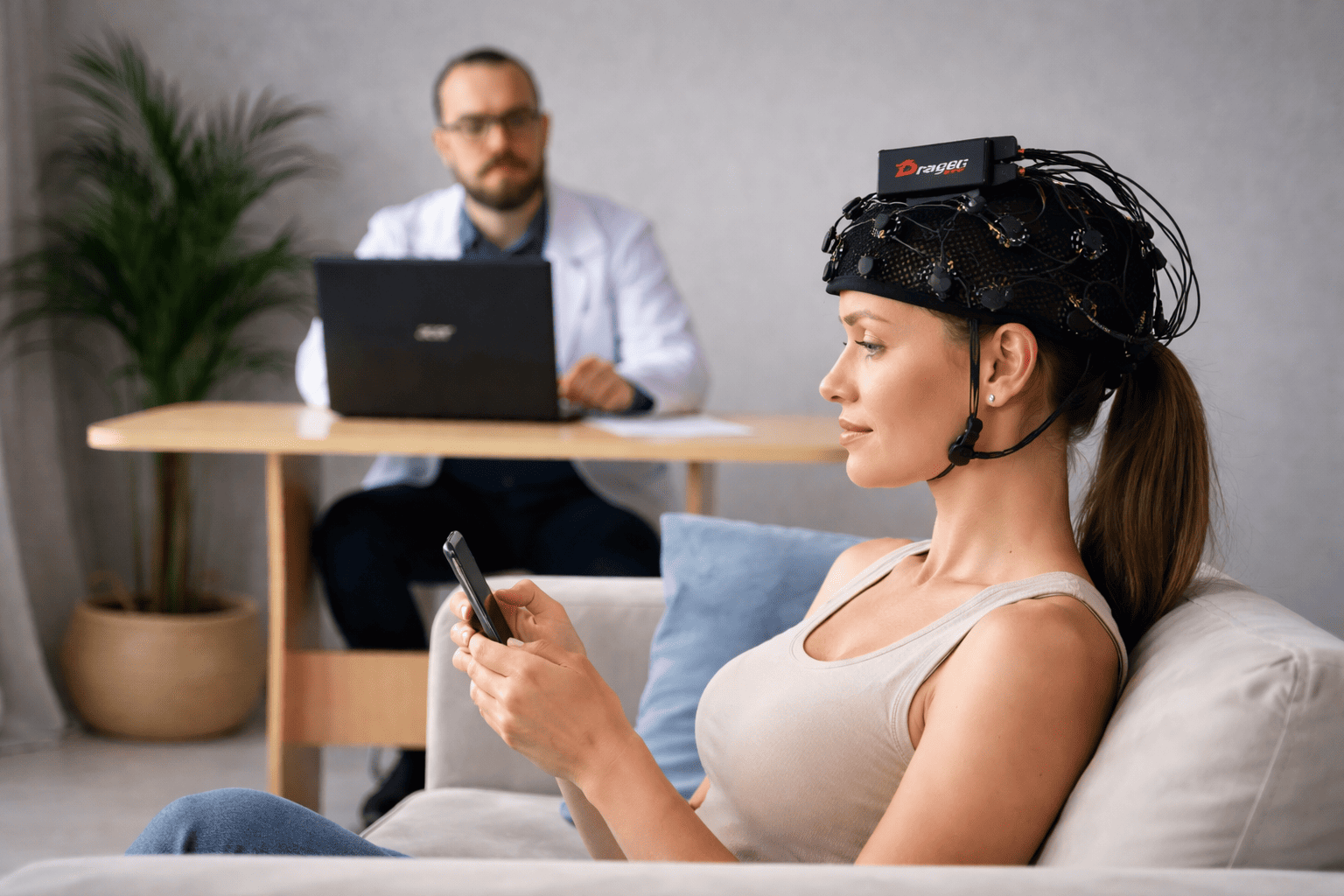
Real-time brain monitoring has transformed from simple wave detection to sophisticated neural analysis. As clinicians and researchers seek more precise tools for cognitive enhancement and emotional regulation, advanced assessment technologies are becoming essential in professional neurofeedback practice.
EEG: From electrical patterns to neural insights
EEG remains the cornerstone of neurofeedback applications, and modern systems demonstrate just how far this technology has advanced. Take DragonEEG - its sophisticated 21-channel configuration following the standard 10-20 system represents the cutting edge of practical assessment technology. Operating at a 500 Hz sampling rate with 24-bit ADC resolution, it captures neural activity within a precise 0 to 0.4V range. This level of precision, backed by 1000 MOhm amplifier input impedance, ensures practitioners capture even the subtlest neural patterns.
Key advantages of modern EEG systems include their excellent temporal resolution, non-invasive nature, and cost-effectiveness for routine clinical use. For practitioners, these systems offer immediate feedback capabilities and proven reliability in various applications. However, practitioners should consider certain limitations: EEG signals can be sensitive to movement artifacts, and spatial resolution is lower compared to some other technologies.
Modern EEG systems have effectively addressed traditional limitations. DragonEEG exemplifies this evolution by incorporating three additional poly channels for EMG, ECG, and EOG measurements, providing practitioners with a comprehensive view of physiological responses. The flexibility of both dry and wet electrode options adapts to diverse clinical needs, while Bluetooth LE connectivity ensures natural movement during sessions.
fNIRS: Blood flow mapping in cortical regions
Functional Near-Infrared Spectroscopy adds another dimension to brain assessment by measuring blood oxygenation levels. Implementation follows standardized approaches, including the established 10-20 and 10-10 systems for optode placement, ensuring consistent and reliable data collection. The technology proves particularly valuable when monitoring specific brain regions, especially the prefrontal cortex.
fNIRS offers distinct advantages in professional settings: superior spatial resolution compared to EEG, robust performance against subject movement, and systematic positioning protocols that enhance reliability. Modern toolboxes and software support precise optode placement, maximizing anatomical specificity to regions of interest. However, practitioners should consider certain implementation factors: while standardized positioning systems aid setup, attention to registration accuracy and channel optimization remains important for optimal results.
fMRI: Deep brain activity visualization
At the cutting edge of spatial resolution, fMRI technology provides detailed insights into brain activity through blood flow measurement. Though its complexity and cost limit routine use, fMRI has proven invaluable in research settings, particularly in understanding the neural mechanisms underlying neurofeedback effects.
fMRI stands out for its unmatched spatial resolution and ability to image deep brain structures with precision. The technology excels in mapping exact locations of neural activity and understanding connectivity patterns. However, significant practical constraints exist: high operational costs, complex infrastructure requirements, and lower temporal resolution compared to EEG. These factors typically restrict fMRI's use to research settings rather than routine clinical applications.
When selecting brain assessment technologies for professional use, several key factors deserve consideration:
Brain monitoring essentials
Modern EEG systems like DragonEEG offer an optimal balance of features for routine professional use. Their wireless capabilities and extended battery life (up to 8 hours) support full clinical days, while quick recharge times (4 hours) minimize downtime. The availability of both dry and wet electrodes provides flexibility for different clinical scenarios.
System selection factors
While fMRI offers superior spatial resolution, its high operational costs often outweigh benefits for routine clinical use. In contrast, modern EEG systems provide excellent value through their combination of precision, reliability, and practical usability. fNIRS occupies a middle ground, offering enhanced spatial precision at a more accessible price point than fMRI.
Clinical integration strategies
Each technology presents distinct implementation requirements. EEG systems like DragonEEG focus on practical usability while maintaining professional standards. For fNIRS, implementation benefits from established positioning systems and specialized toolboxes that optimize optode placement and data quality. These tools help maintain consistent standards across sessions while maximizing anatomical specificity. fMRI implementation requires specialized facilities and equipment, primarily restricting its use to research settings.
Neural assessment evolution
The field continues to advance, driven by technological innovation and deepening understanding of neural function. While newer technologies like fNIRS and fMRI offer valuable insights, practical considerations maintain EEG's position as the primary tool for routine neurofeedback applications. The continued development of systems like DragonEEG, which balance technical sophistication with practical usability, suggests a future where increasingly precise brain assessment becomes more accessible and applicable in various settings.
Brain monitoring in practice
Modern brain assessment represents a convergence of multiple technologies and approaches. Each assessment method offers unique advantages, with EEG providing excellent temporal resolution and practicality, fNIRS offering targeted monitoring capabilities, and fMRI contributing detailed spatial information. Through modern systems like DragonEEG, practitioners now have access to sophisticated tools that enable detailed analysis of brain activity, supporting both research initiatives and clinical interventions in the growing field of neurofeedback.